Training Employees to Use AI: Clear Communication Matters

AI is showing up everywhere at work. Employees are using AI-powered tools to draft emails, summarize information, generate ideas, and complete routine tasks more quickly. AI adoption isn’t slowing down—73% of employers say hiring AI-skilled talent is a priority, and more than 90% expect to use AI solutions by 2028, according to research from Amazon Web Services and Access Partnership.
For HR, L&D, and business leaders, this raises an important question. How can employees use this powerful tool effectively in their day-to-day work?
They have access to AI, but they don’t always know how to use it effectively. Some achieve great results. Others miss the mark. Many also aren’t sure when to trust what AI produces or when to question it. This comes down to how individual employees use the tool.
Changing How Work Gets Done
AI can feel powerful, even a little intimidating. It produces polished responses quickly. It sounds confident. It often looks like it “knows” what it’s doing.
In reality, AI is a system trained in patterns in language. It predicts the next words based on the input it receives. AI capabilities include generating ideas, drafting content, and offering suggestions.
But, AI can’t think independently, have experiences or opinions, or apply human reasoning. That’s why AI training matters.
The most effective way to use AI is to act as a collaborator. Human beings bring judgment and direction. AI brings speed and ideas.
Clear Communication for Effective AI Use
AI tools are designed to respond to natural language in the same way one might talk to team members. As a result, communication skills play a crucial role in how employees use AI. Every engagement with AI starts with using a prompt. And the quality of the specific prompt shapes the quality of the AI output.
A vague request such as “Help me write an email” leaves too much open to interpretation.
Specific prompts, like “Help me write a short, professional email to a customer explaining a missed deadline,” provide AI with clearer guidance and produce more useful results.
If a prompt is unclear, AI may fill in the gaps with guesses and proceed in the wrong direction. This is why prompting is an essential skill for using AI effectively.
The Skills Behind Effective AI Use
For AI training to be beneficial, it should center on practical skills employees can apply immediately on the job. These skills shape how they guide AI, interpret responses, and refine the result.
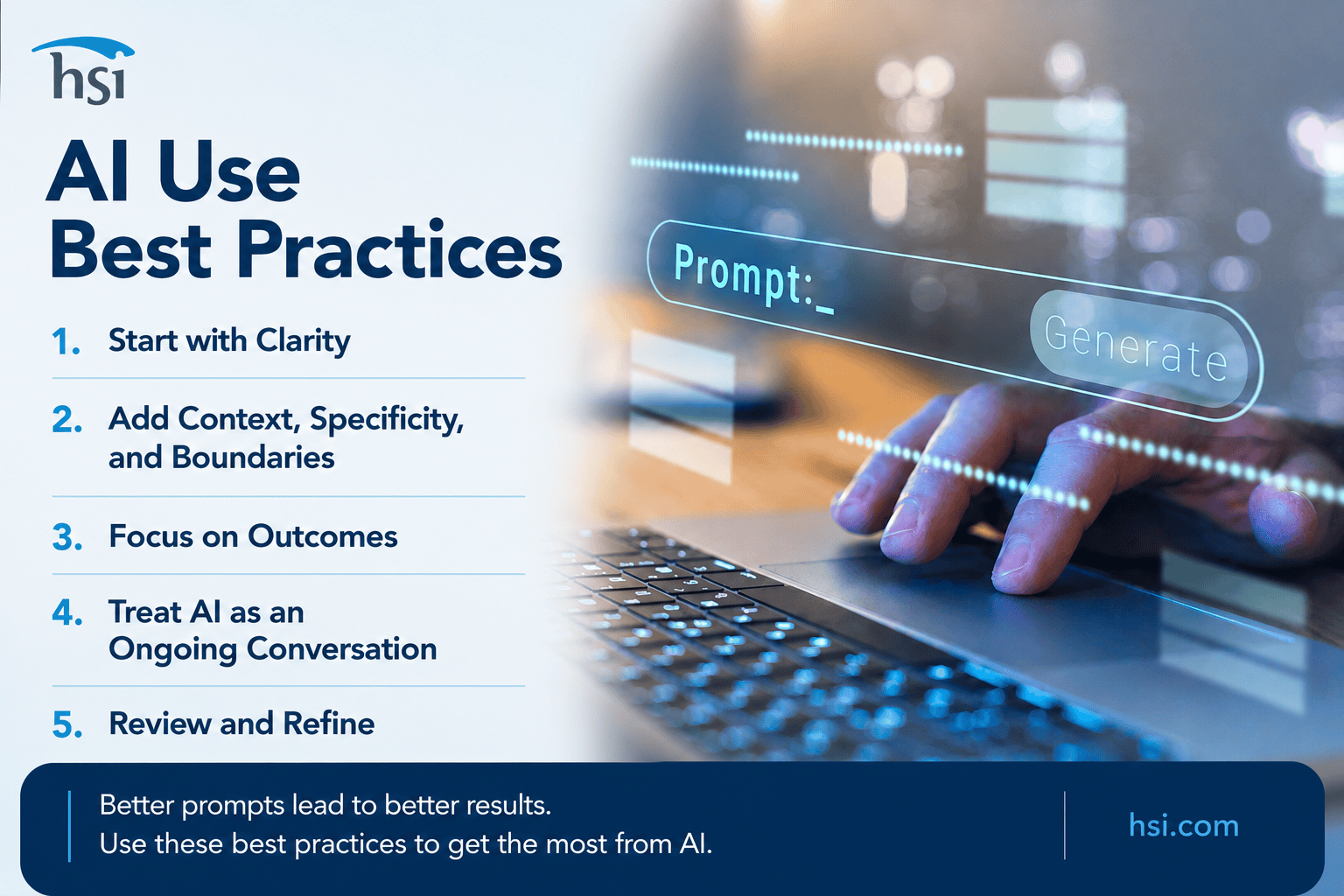
AI best practices include:
1. Start with clarity. AI works best when it has a clear goal. Before writing a prompt, employees should be able to answer a few basic questions:
- What am I trying to accomplish?
- Who is this for?
- What kind of response do I need?
These steps reduce guesswork and improve the quality of AI output.
2. Add context, specificity, and boundaries. AI produces better results when it has direction. Three elements consistently improve outputs:
- Context provides background or perspective.
- Specificity narrows the request.
- Boundaries define things like tone, format, or length.
Without these, AI fills in missing information on its own. With them, it understands the ask.
3. Focus on outcomes. Thinking about the desired outcome can help guide the AI more effectively. Instead of outlining every step, employees can describe:
- What the result should accomplish.
- What the audience should understand.
This helps guide AI toward more relevant responses.
4. Treat AI as an ongoing conversation. AI tools are designed to be interactive. Employees can:
- Ask for revisions.
- Adjust tone or format.
- Clarify what’s missing.
This allows employees to get real-time feedback and improve their prompts and outputs as they go. If something seems wrong, they can guide the AI in a different direction. This back-and-forth helps improve results over time.
5. Review and refine.
AI-generated content should be treated as a draft. It still needs review, editing, and ownership. Reviewing AI-generated content is a crucial step before it is used in real work or shared with others. Employees should take time to:
- Review for accuracy.
- Confirm the message reflects their intent.
- Adjust tone along with clarity as needed.
AI Skills and Human Skills
Using AI effectively depends on skills employees already use. These include communication skills, writing, critical thinking, judgement, and emotional intelligence. These skills influence how employees guide AI and evaluate outputs. They are also important throughout broader workplace communication.
AI can help generate ideas and drafts, but it doesn't replace the need to shape, refine, and evaluate the final output. Harvard Business Review notes that although AI can improve performance, it doesn’t eliminate the need for human expertise. For example, AI-generated content may need to be revised to sound more natural. For HR and L&D leaders, this reinforces that AI training works best when it is paired with broader soft skills development.
Why Training Matters
Providing access to AI tools is only the first step. To use these tools effectively, employees need guidance and support. Following best practices in how employees learn and apply AI skills helps ensure consistent AI adoption use across team members. Without effective training, employees may not fully use AI capabilities or may produce inconsistent results.
With training, they can write clearer prompts, responses become more useful, and confidence in using AI improves. As employees continue to use AI, it becomes part of everyday work rather than something they use occasionally.
What HR and L&D Leaders Should Focus On
To build AI capability across the workforce, business leaders need a strategic approach to training.
- Focus on routine tasks employees already perform.
- Build skills in prompting and clear communication.
- Reinforce review, editing, and accountability.
- Connect AI use with additional workplace skills.
The goal is not to turn them into AI experts. It is to help them use AI effectively in their work.
AI is changing how work gets done. But the quality of the output still depends on the person using it. Clear thinking leads to clearer prompts. And clearer prompts lead to more useful results.
HSI Can Help
For HR and L&D leaders, the challenge isn’t just introducing AI—it’s building consistent capability across the organization. As L&D analyst, Josh Bersin notes, “learning happens in the flow of work,” making it critical that employees can apply AI skills in real time.
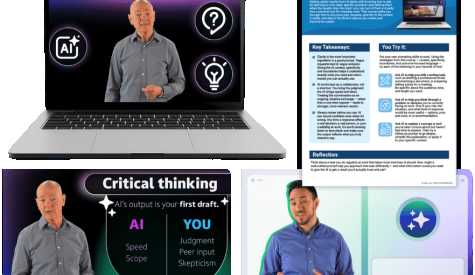
HSI supports organizations with microlearning how-to videos and articles with real-life scenarios to deliver just-in-time support, helping employees apply AI skills at the right time in the flow of work. This includes writing specific prompts to validate outputs.
Through this strategic approach, HSI helps organizations train employees to:
- Build practical AI skills such as prompting and responsible use.
- Strengthen writing and communication skills for better AI interaction.
- Develop critical thinking and judgment to evaluate AI outputs.
Together, these skills support more effective AI use across the workforce and add to overall employee engagement. To learn more, request a consultation.
Related Articles
Gen Z and AI: What Learning Leaders Need to Know
Help Gen Z overcome AI anxiety. Learn how L&D leaders can build AI skills, close gaps, and strengthen soft skills for a...
Employee Training & Development
Artificial Intelligence (AI) Skills
Online AI training for your entire workplace. Help build AI skills that drive productivity, improve decisions, and...
Employee Training & Development
Artificial Intelligence (AI) Training Videos
Online AI training for your entire workplace. Artificial intelligence sits atop everyone’s minds as it continues...
Employee Training & Development