Your AED May Be Ready. Is Your AED Program? Six Questions Every Organization Should Ask.

Here's how to evaluate your organization's AED program and identify the gaps that could make a difference when every second counts.
An automated external defibrillator (AED) is one of the most important pieces of emergency response equipment an organization can have. When someone experiences sudden cardiac arrest, an AED can help restore a potentially lifesaving heart rhythm when used promptly, along with CPR.
Many organizations have made the investment. They've purchased AEDs, installed cabinets, and provided CPR and AED training. On paper, it may appear that everything is in place.
But there's an important distinction between owning an AED and maintaining a comprehensive AED program so everything is in place and ready to respond when an emergency happens.
- Who makes sure the equipment is ready?
- Are replacement pads and batteries being monitored?
- Can employees access an AED during every operating shift?
- Are enough people trained to respond?
- What happens when an AED is used or when the person responsible for managing the program leaves the organization?
These questions often reveal problems that aren't obvious during routine operations.
In other words, the AED itself may be ready, but the organization around it may not be.
Whether your organization manages one AED or hundreds across multiple buildings and locations, periodically evaluating your program can help identify gaps before an emergency exposes them.
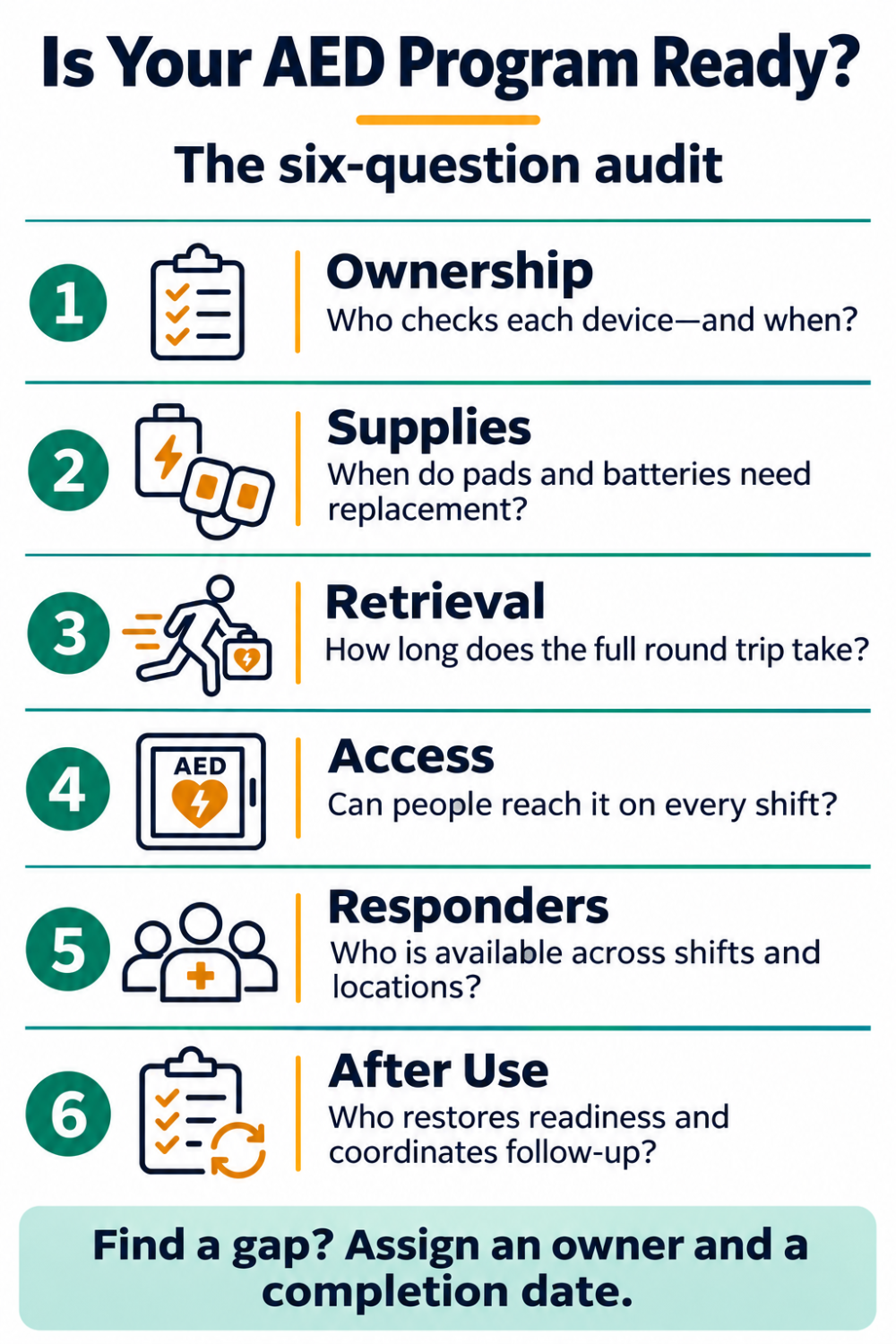
Here are six questions every organization should ask.
1. Who Is Responsible for Inspecting and Maintaining Each AED?
One of the most common weaknesses in AED programs is unclear ownership.
Ask someone who manages your workplace safety program who checks the AEDs, and you might hear:
- Facilities takes care of that.
- Our safety coordinator handles it.
- Someone checks them every month.
- The AED tells us if something is wrong.
Those answers may sound reassuring, but they don't necessarily describe a reliable inspection and maintenance process.
Every AED should have an assigned person responsible for routine physical inspections, with a designated backup to ensure inspections continue during vacations, absences, or personnel changes.
Your organization should be able to answer several basic questions:
- Who is responsible for physically inspecting each AED?
- How frequently are inspections performed?
- What specific items are checked?
- Where are the inspection results documented?
- Who is notified when an issue is discovered?
- Who verifies that the issue has been resolved?
A documented inspection process should follow the AED manufacturer's instructions and applicable workplace requirements. Depending on the equipment, inspections may include checking the status indicator, confirming that the device is in its designated location, examining the cabinet and accessories, and verifying that required supplies are present and within their expiration dates.
It's also important to understand the difference between an AED's automatic self-test and a physical inspection.
An AED may automatically test certain internal components and alert users to a problem. However, it cannot identify a missing accessory, a damaged cabinet, an obstructed access route, or an AED that has been moved from its assigned location.
That's why human oversight remains essential.
What to do: Create a master inventory of every AED in your organization. Assign a primary inspector and backup for each location, establish a documented inspection schedule, and create a process for reporting and resolving problems.
Ask to see the most recent inspection records. If you cannot quickly identify who checked a particular AED and when, you have an opportunity to strengthen your program.
2. Do You Know When AED Pads and Batteries Need to Be Replaced?
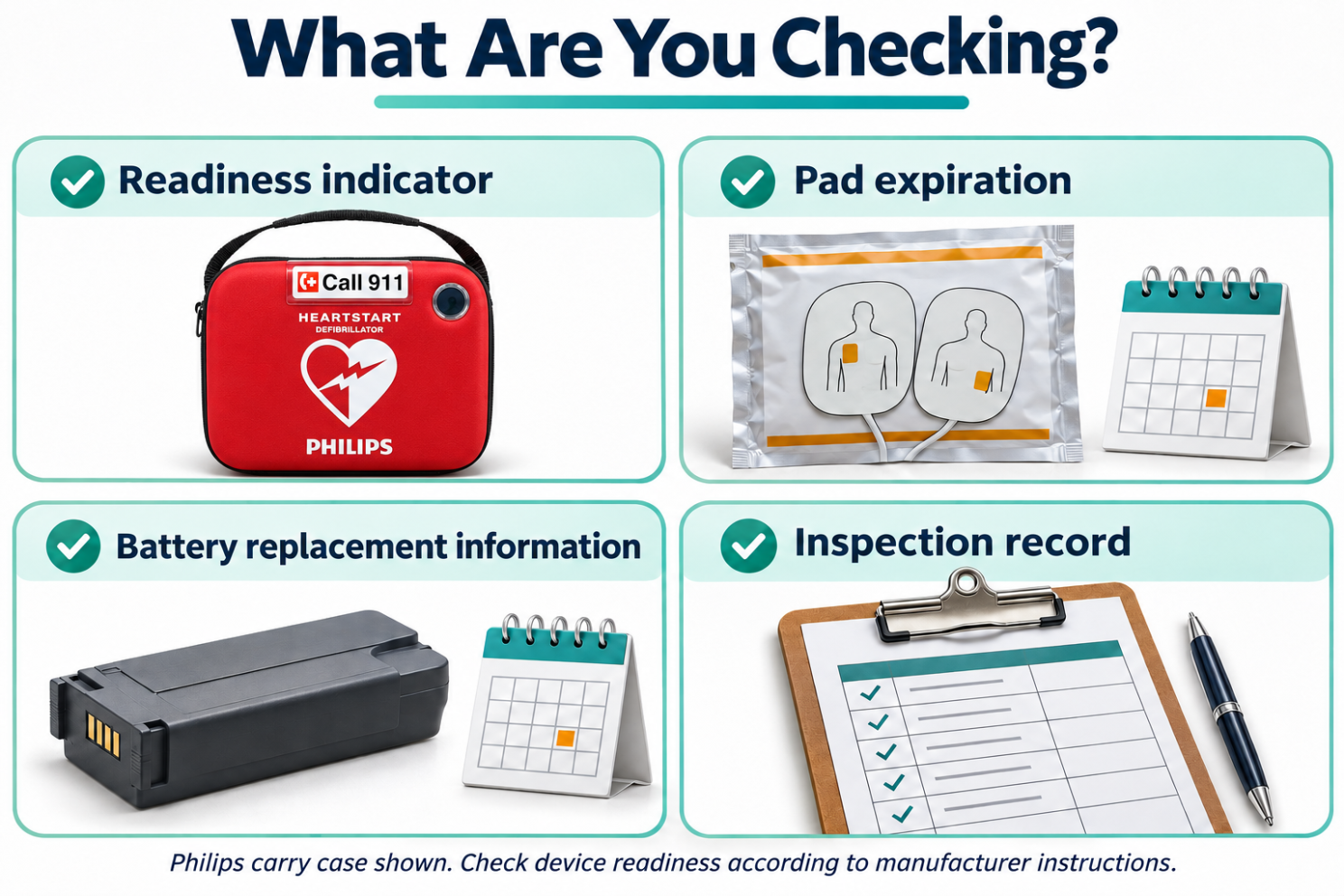
An AED is a long-term investment, but its accessories and consumable supplies expire and have replacement requirements that need ongoing attention.
Pads and batteries are among the most important items to monitor.
AED electrode pads have expiration dates because their adhesive, conductive properties, and other components can deteriorate over time. Batteries also have manufacturer-defined replacement or service-life requirements.
If supplies are expired, damaged, missing, or otherwise unsuitable for use, the AED may not be ready when needed.
The challenge is that organizations don't always have a reliable way to track these dates.
Consider an organization with 15 AEDs distributed across three buildings. Each device may have different pad expiration dates, battery requirements, and replacement schedules. Add pediatric pads, spare batteries, and other accessories, and the amount of information quickly becomes difficult to manage manually.
A few missed reminders can create unnecessary risk. At a minimum, your AED inventory should track:
- AED manufacturer, model, and serial number.
- Exact device location.
- Adult electrode pad expiration dates.
- Pediatric electrode pad expiration dates, when applicable.
- Battery replacement dates or service-life requirements.
- Replacement product information and ordering contacts.
Don't assume every AED uses the same supplies or follows the same replacement schedule. Requirements vary by manufacturer and model, so records should reflect the actual equipment in your organization.
Establish reminders far enough in advance to allow time for purchasing, shipping, and installation. For example, a 60-day advance reminder may be a useful starting point, but the appropriate lead time will depend on your organization's procurement process and supplier availability.
What to do: Maintain a centralized expiration-date tracking system that automatically alerts the appropriate person before supplies need replacement. Include a process for confirming that new supplies have been installed and the inventory has been updated.
The goal isn't simply to know when something expires. It's to make sure the AED is equipped with the supplies it needs before that date arrives.
3. How Quickly Can Someone Retrieve an AED During an Emergency?
An AED stored in a cabinet at the opposite end of a building may be technically available, but how useful is it if it takes several minutes to retrieve?
The only way to know is to test it.
Start by identifying the areas where a cardiac emergency could occur. Think beyond the main office or reception area.
Consider:
- Manufacturing floors and production areas.
- Warehouses and loading docks.
- Break rooms and cafeterias.
- Conference rooms and training facilities.
- Fitness centers and recreational areas.
- Parking garages and outdoor workspaces.
- Remote buildings and outlying facilities.
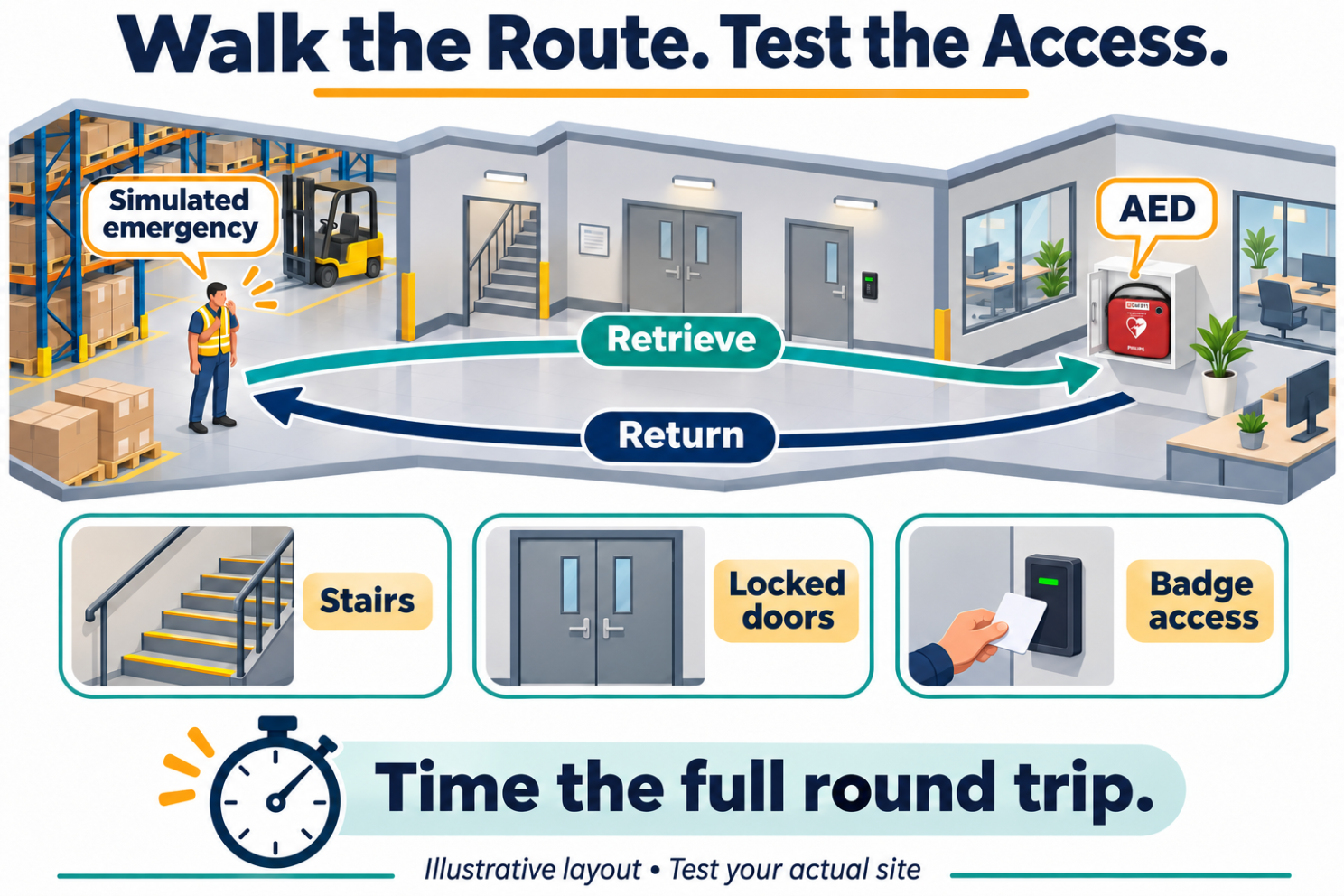
Then walk the route from each area to the nearest AED.
Time the entire round trip, including the time needed to locate the device, navigate hallways, use elevators or stairs, pass through secured doors, retrieve the AED, and return to the person experiencing the emergency.
A three-minute or less retrieval time can be used as a practical planning target when evaluating AED placement, although it should not be interpreted as a universal regulatory requirement or a guarantee of adequate coverage. Faster access is better, and organizations should consider their specific facility, risks, and emergency response needs.
Why does retrieval time matter?
Sudden cardiac arrest is a time-critical emergency. CPR helps maintain blood flow, while an AED analyzes the heart's rhythm and delivers a shock when indicated. Prompt CPR and defibrillation are critical components of the response.
The sooner an AED reaches the person, the sooner it can be applied.
Remember that AED retrieval is only one part of the response. Ideally, multiple responders work together. One person calls 911, another begins CPR, another retrieves the AED, and someone else helps direct emergency medical services to the scene.
A timed drill can reveal problems that aren't obvious on a facility map. You may discover that a door is routinely locked, an AED cabinet is difficult to locate, or a particular work area is farther from the nearest device than expected.
What to do: Conduct a physical AED accessibility assessment. Identify high-risk and high-occupancy areas, time retrieval routes, and evaluate whether additional devices or different placements are needed.
Don't assume your AED locations are adequate simply because they were appropriate when the devices were first installed. Buildings, staffing, operations, and floor plans change. Your AED placement strategy should change when necessary, too.
4. Can Employees Access the AED Whenever People Are on Site?
An AED is only useful if someone can reach it. This sounds obvious, but accessibility problems are surprisingly easy to overlook.
Imagine an organization that keeps its AED in a main office hallway. The building is open Monday through Friday, 8 a.m. to 5 p.m. During those hours, employees can easily access the device.
But what happens when the maintenance crew works overnight? What about employees arriving early, weekend shifts, contractors, visitors, or special events?
If the AED is behind a locked office door or inside a restricted area, it may not be available when an emergency occurs.
Accessibility should be evaluated based on how your organization operates, not just its standard business hours. Consider the following:
Operating hours: Are AEDs accessible during early mornings, evenings, overnight shifts, weekends, and holidays?
Building security: Are devices located behind badge readers, locked doors, or other access restrictions?
Employee and visitor access: Can contractors, temporary workers, visitors, and employees unfamiliar with the facility locate and retrieve an AED?
Visibility and signage: Are AED locations clearly identified? Can someone unfamiliar with the building find the device without asking for directions?
Outdoor and remote areas: Are employees working in parking lots, outdoor facilities, or separate buildings able to reach an AED quickly?
Also consider whether AED cabinets are accessible and clearly marked. A device hidden inside an office or stored in an unmarked cabinet may be difficult to locate during a stressful emergency.
What to do: Evaluate every AED location during different operating conditions. Walk the building during evening or weekend hours, test badge access, and ask employees who aren't part of the safety team to locate the nearest AED.
Their experience may reveal problems your regular safety inspections miss.
5. Do You Have Enough Trained Responders Across All Shifts and Locations?
Having trained employees is an important part of an effective AED program. But the number of people who have completed training doesn't necessarily tell you whether your organization has adequate emergency response coverage.
For example, an organization may have 12 employees trained in CPR and AED use. That sounds like a strong foundation.
But what if 10 of those employees work in the same building, during the same daytime shift?
What happens when an emergency occurs at a different location, during the evening shift, or when several trained employees are on vacation?
Evaluate your coverage across:
- Buildings and physical locations.
- Individual floors and work areas.
- Day, evening, and overnight shifts.
- Weekends and holidays.
- Seasonal staffing changes.
- Remote and hybrid work arrangements.
Employee turnover is another important consideration. When a trained responder leaves the organization, their replacement may not have equivalent training.
Training records should be monitored so that expiring certifications, upcoming refresher needs, and staffing changes don't create unexpected coverage gaps.
Organizations should also consider the possibility that a designated responder may be the person experiencing an emergency.
Your emergency response plan should never depend entirely on one individual or require employees to wait for a designated responder before taking appropriate action.
All employees should understand how to recognize a cardiac emergency, activate the emergency response system, call 911, begin CPR, and retrieve and use an AED. AEDs provide voice and visual prompts to guide users through operation, and employees should know they can follow those prompts.
What to do: Evaluate training coverage by shift, location, and work area rather than relying on a company-wide headcount. Identify gaps, establish a process for maintaining training records, and provide appropriate CPR and AED training opportunities.
Consider conducting periodic drills to help employees understand their responsibilities and become more comfortable responding.
6. What Happens After an AED Is Used?
An AED being used is a significant event, and the organization needs a clear process for restoring its emergency response capabilities. Once emergency medical services have taken over, several important responsibilities remain.
Restore the AED to service.
Used electrode pads must be replaced, and the device must be checked and prepared for future use according to the manufacturer's instructions. Other supplies may also need replacement.
Document the event.
Your organization should have a process for completing applicable incident documentation and reporting. Follow organizational policies, manufacturer instructions, and relevant legal or regulatory requirements.
Preserve and coordinate device information.
Some AEDs store event information, such as heart rhythm data and usage records. Determine how that information should be preserved and made available to appropriate medical personnel or other authorized contacts, consistent with applicable privacy requirements and manufacturer instructions.
Arrange temporary coverage.
If an AED is removed from service, your organization should determine whether a replacement device or another temporary response measure is necessary while the original equipment is restored.
Review the response.
After an incident, consider conducting an appropriate debrief with the people involved. What worked well? Were there delays? Could responders find the AED? Did everyone understand their responsibilities?
The purpose of a debrief is to identify opportunities for improvement and support the individuals involved, not to assign blame.
It's important to establish these responsibilities before an emergency happens. When an AED is used, people may be dealing with a stressful and emotional situation. They shouldn't have to figure out the organization's procedures from scratch.
What to do: Develop a post-use checklist that identifies who is responsible for restoring the AED, ordering supplies, documenting the event, coordinating any required follow-up, and confirming the device is back in service.
A device that has been used but not properly restored is another potential gap in your emergency response program.
Beyond the Six Questions: Build a System That Keeps Your AED Program Ready
Answering these six questions is a great starting point. But the real value comes from turning your answers into an organized, ongoing AED management process.
For many organizations, AED management starts with a spreadsheet, a calendar reminder, and a few people who know where everything is located. That approach may work when an organization has only one or two AEDs and a single person overseeing the program.
As the organization grows, however, managing AEDs becomes more complicated.
Multiple locations, different AED models, varying expiration dates, employee turnover, inspection schedules, and purchasing requirements can create a significant administrative burden.
A centralized management approach helps reduce that dependency. At a minimum, organizations should establish a single, accessible record for every AED that includes:
- Device manufacturer, model, and serial number.
- Building, floor, and exact placement.
- Pad and battery expiration or replacement information.
- Required accessories and supplies.
- Assigned inspector and backup.
- Inspection frequency and completed inspection records.
- Outstanding maintenance issues.
- Replacement product and supplier information.
- Post-use procedures and assigned responsibilities.
The system should also provide a reliable way to identify upcoming tasks, communicate problems, and document completed work.
Whether you use a spreadsheet, an existing facilities management platform, or a dedicated AED management solution, the system should help you answer three questions quickly:
- What needs attention?
- Who is responsible?
- Has the issue been resolved?
If it takes hours to gather this information, or if only one person knows where to find it, your program may be more difficult to maintain than it needs to be.
Make AED Management Part of Your Overall Workplace Safety Program
AED readiness shouldn't exist in isolation. It should be connected to your organization's broader emergency response and workplace safety efforts.
Consider integrating AED management with the following activities:
CPR, AED, and First Aid Training: Make sure employees receive appropriate training and understand how to respond to a cardiac emergency. Maintain training records and identify opportunities to improve coverage.
Emergency Response Planning: Document procedures for calling 911, initiating CPR, retrieving an AED, coordinating responders, and directing emergency medical services to the scene.
Regular Drills: Practice emergency scenarios in different areas of your facility. Use drills to identify access problems, communication gaps, and opportunities to improve response coordination.
Equipment Management: Include AEDs in your broader equipment and maintenance management processes. If your organization also manages first aid kits, bleeding control supplies, and other emergency equipment, consider whether these items can be monitored through a coordinated system.
Program Reviews: Evaluate your AED program periodically and whenever significant organizational changes occur, such as opening a new facility, changing operating hours, relocating equipment, or experiencing substantial employee turnover.
Also review applicable federal, state, and local requirements, along with AED manufacturer recommendations. AED program requirements can vary by jurisdiction and workplace setting, so organizations should not assume that a single checklist satisfies every applicable obligation.
The objective is to create a sustainable program that doesn't depend on one person remembering every detail.
Simplify AED Program Management With HSI
Maintaining an effective AED program requires more than purchasing the equipment. It requires ongoing inspections, expiration-date monitoring, maintenance, employee training, and accountability.
For organizations managing multiple AEDs or locations, keeping all of that information organized can quickly become a challenge.
HSI offers an AED & Equipment Manager solution designed to help organizations simplify the ongoing management of their emergency response equipment.
Instead of relying solely on disconnected spreadsheets, calendars, and individual reminders, organizations can use a more centralized approach to managing equipment information and readiness responsibilities.
HSI also has AEDs, replacement supplies, CPR and First Aid training programs, and other workplace safety products and resources to help organizations support their emergency preparedness efforts.
Whether you're evaluating your first AED or overseeing equipment across multiple facilities, HSI can help you determine the right AED for your organization.
Related Articles
What is the Pediatric Chain of Survival?
The pediatric chain of survival outlines a series of steps and interventions designed to maximize the chances of saving...
Emergency Care

Heart Month Safety Check: Are AEDs Accessible Where You Live, Work, and Play?
Heart Month reminder: Check if AEDs are visible, accessible, & ready where you live, work, & gather - because every...
Emergency Care

Top 12 Myths About Sudden Cardiac Arrest
For SCA Awareness Month, let’s debunk the top 12 myths about sudden cardiac arrest to help raise awareness and increase...
Emergency Care
