AI at Work: Where It Delivers and Where It Doesn’t

Artificial intelligence (AI), especially generative AI, is rapidly becoming part of everyday work. It appears in new AI tools, workplace conversations, and organizational strategies. As AI’s impact continues to grow across roles and industries, successful AI adoption depends on employees’ understanding of how to use it effectively and where its limits matter. While some view it as a breakthrough solution and others approach it with caution, the reality is more balanced. The promise of AI is significant, but so are its limitations.
AI is not a replacement for human expertise, nor is it inherently risky. It is a tool. And like any workplace tool, its effectiveness depends on how and when it is used.
For organizations and employees alike, the key is understanding where AI adds real value and where human judgment must remain central.
What AI Actually Is (and Isn’t)
AI does not understand context, intent, or consequences in the way people do. It does not make decisions based on values or lived experiences. This is particularly true for generative AI, which creates content by predicting patterns in data rather than truly understanding meaning.
Instead, AI systems identify patterns in large volumes of data and generate outputs based on those patterns. This is what allows AI to produce content quickly and confidently, but also why it can be incorrect or misleading.
This distinction is critical for workplace use:
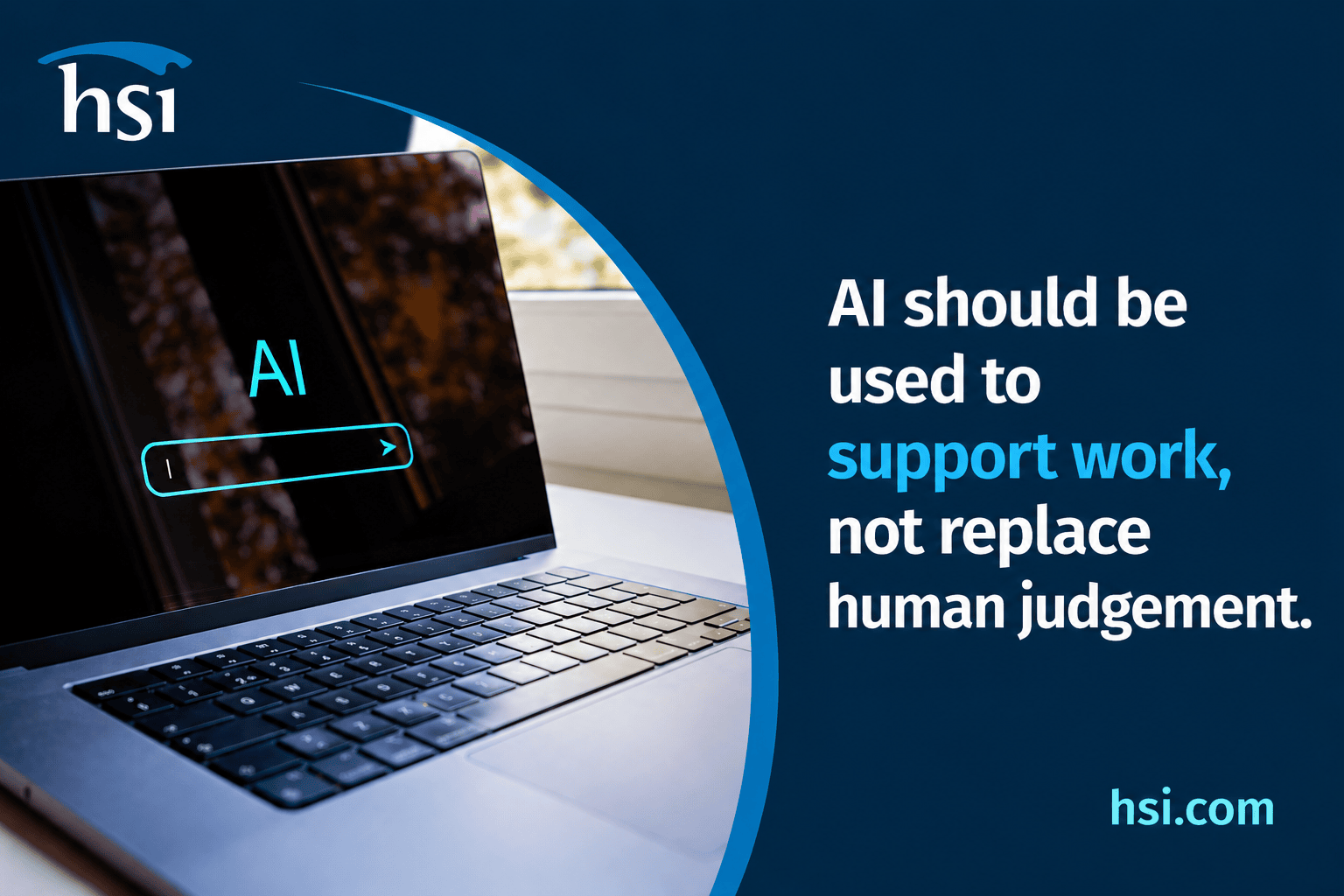
AI should be used to support work, not replace human judgment.
When this boundary is unclear, the risk of errors, miscommunication, and poor decision-making increases.
Where AI Delivers Real Value
AI is most effective when applied to low-risk, support-oriented tasks using AI tools. These common workplace use cases improve efficiency, reduce cognitive load, support individual tasks, and help employees complete tasks more efficiently, and streamline business processes.
Real-world examples include:
- Drafting content: Generative AI tools can generate initial drafts of emails, reports, presentations, and social media posts. They can also help draft responses to common customer service inquiries often handled by customer support agents, making it easier to move past the blank page.
- Summarizing information: AI tools can condense lengthy documents, meeting notes, or research into key themes and highlights, allowing employees to focus on interpretation and next steps.
- Brainstorming ideas: AI tools can suggest alternative approaches, generate ideas, and support creative thinking. It can expand options, but it does not determine direction.
- Organizing content: AI tools can structure information and reformat materials for clarity. Employees remain responsible for prioritization and accuracy.
- Identifying patterns in data: With proper oversight, AI tools can surface trends or anomalies in large datasets. However, interpreting those patterns and determining appropriate action requires human insight.
In each of these scenarios, AI enhances individual productivity while keeping control and accountability with the employee. Recent United States research shows that employees using generative AI save an average of over two hours per week, contributing to measurable productivity gains, and in some cases, AI has been shown to improve worker performance by up to 40% when used appropriately.
A useful guideline for applying AI in these contexts is:
If AI generates the output, a human should review the AI output. If the outcome has an impact, a human should make the decision.
Where AI Doesn’t Deliver
AI becomes less reliable as tasks shift from support to more complex decision-making processes, particularly when the stakes are higher. It is not well-suited for decisions that affect people, financial outcomes, safety, or organizational risk.
AI lacks the ability to fully account for:
- Interpersonal dynamics
- Emotional context
- Ethical considerations
It also cannot independently verify whether its outputs are accurate or appropriate. While AI responses may appear confident, that confidence does not guarantee correctness, and it may raise concerns around data privacy.
When Human Judgment Is Required
Situations involving accountability should always remain under human control. This includes decisions related to:
- Ethics and compliance
- Employee performance and well-being
- Safety and risk management
- Organizational impact
The following use case illustrates where AI support may be helpful, but where human judgment must remain central: A manager addressing a sensitive performance issue may use AI to organize thoughts or draft communication. However, determining how to approach the conversation requires judgment, context, and responsibility that AI cannot provide.
A practical rule of thumb is:
If you are accountable for the result, make the decision yourself. Do not rely entirely on AI to decide.
The Right Approach: AI as a Support Tool
The most effective way to integrate AI into the workplace is to treat it as a support tool rather than a decision-maker.
AI tools can boost efficiency in drafting, summarizing, organizing, and generating ideas. Employees must still review outputs, apply context, and make final decisions.
The most effective use of AI happens at the individual level, where employees apply judgment, context, and accountability to every task.
When evaluating whether to use AI, a simple question can help guide appropriate use:
Is this a task AI can support, or a decision that requires human judgment?
Maintaining this distinction creates a strong foundation for using AI effectively while minimizing risk.
As AI investment grows across organizations, business leaders set the direction through an AI strategy, while L&D leaders play a critical role in supporting successful AI adoption by ensuring employees understand how to use these tools effectively. The return on that investment depends on employees knowing when to rely on AI and when to rely on their own judgment. Ultimately, AI ROI is driven not just by the tools organizations adopt, but by how well employees are trained to use them, collaborating with AI while retaining ownership of decisions, accountability, and outcomes.
HSI Can Help
As AI becomes more integrated into everyday work, organizations face a growing need to ensure employees understand not just how to use AI tools but how to use them responsibly.
HSI supports L&D and business leaders with training content that helps employees use AI tools effectively, build practical AI skills, and reinforce critical thinking, ethical decision-making, and accountability. This leads to more consistent performance and better results across teams. From understanding AI’s capabilities and limitations to applying it appropriately in real world workplace scenarios, HSI’s courses are designed to bridge the gap between awareness and application.
Related Articles
Artificial Intelligence (AI) Skills
Online AI training for your entire workplace. Help build AI skills that drive productivity, improve decisions, and...
Employee Training & Development

Artificial Intelligence (AI) Training Videos
Online AI training for your entire workplace. Artificial intelligence sits atop everyone’s minds as it continues...
Employee Training & Development
Are Soft Skills Still Valuable in an AI-Driven World?
Read our blog to learn why soft skills are still valued in the AI era and how they can make AI better.
Employee Training & Development