Effective Coaching Techniques in the Workplace: Tips to Ignite Potential

How to coach employees to ignite potential, why coaching is an effective leadership technique, and ways to teach first-time managers how to coach.
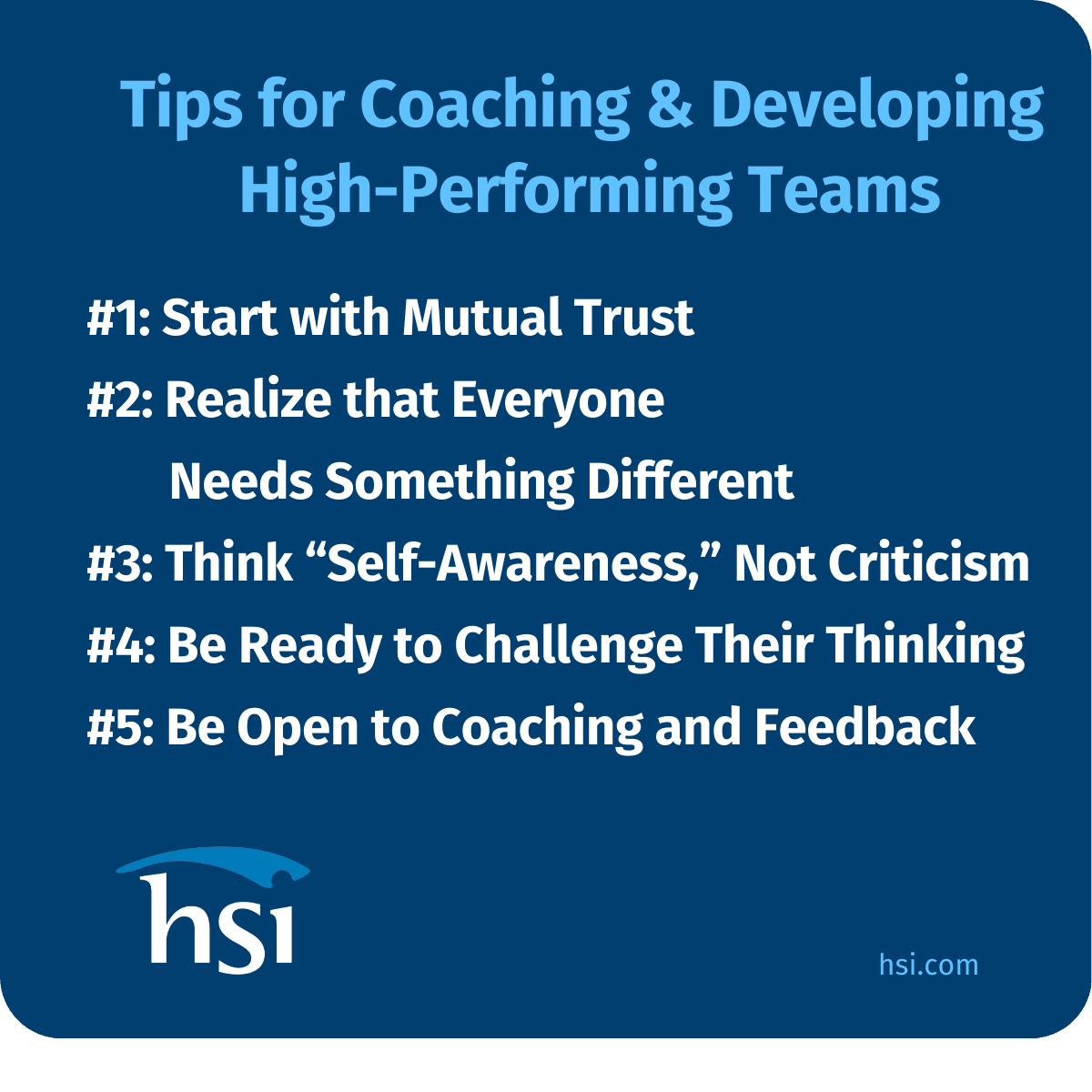
This article outlines tips for coaching and developing high-performing teams:
- #1: Start with Mutual Trust
- #2: Realize that Everyone Needs Something Different
- #3: Think “Self-Awareness,” Not Criticism
- #4: Be Ready to Challenge Their Thinking
- #5: Be Open to Coaching and Feedback
HSI offers leadership development training, including coaching skills and a wide variety of off-the-shelf programs for employees’ professional growth.
Some leaders get to where they are by working hard and learning the ropes. Some also seem to have an innate ability to motivate and inspire others. But a good work ethic, a charismatic personality, or powers of persuasion are not enough. To truly lead in the workplace, employees must learn effective coaching techniques. Coaching is a key factor in developing the workforce, so every internal development plan should not only include coaching but also teach your managers and supervisors how to be effective coaches.
Why Is Coaching an Effective Leadership Technique?
Coaching is about fostering independence and igniting the potential in those being coached. HR leaders and managers who adopt a coaching style put the employees in the driver’s seat, empowering them to make their decisions on their own. As employees gain responsibility for outcomes, their self-confidence increases. This fosters continued professional development, insight, and motivation, which in turn leads to a coaching culture with stronger workplace relationships, boosted employee engagement, increased productivity, and employee job satisfaction.
Research from the International Coaching Federation and the Human Capital Institute found that organizations with strong coaching cultures are more than twice as likely to be high performing (61% vs. 27%).
A coach is not just a cheerleader who gives nothing but praise and high-fives for jobs well done. Nor are they a drill sergeant who shouts out strict rules and reprimands. Coaching effectively means striking a balance regarding guidance, motivation, challenges, constructive feedback, and a supportive environment.
Coaching is a “thought-provoking and creative process that inspires people to maximize their personal and professional potential.” - International Coaching Federation
Ways to Teach First-Time Managers How to Coach
A recent McKinsey & Company Global Survey of executives reported that 87% of those surveyed say they either are currently experiencing skill gaps across the organization or expect skill gaps within a few years. While that may be true, management also needs to recognize the specific skills gaps that may exist among their own team members. Research shows leaders need stronger employee coaching capabilities as they lack key workplace coaching and employee development skills.
As first-time managers navigate their changing roles, they may not understand the nuances of managing vs. coaching. They need to know the appropriate mix of coaching and direction to help them perform at their full potential. At the same time, first-time managers need some coaching from their manager, as well. A supportive environment of ongoing guidance and effective coaching techniques is appropriate at all levels throughout organizations.
The following tips outline best practices for coaching and developing high-performing teams.
Tip #1: Start with Mutual Trust
Trust needs to build over time between the manager and their team members. It’s a two-way street.
As responsibilities are added to employees’ roles, their performance will impact the manager’s level of trust in their abilities and commitment. Leaders must resist the urge to micromanage. Mistakes and failures are bound to happen. Managers and supervisors should use these as learning moments to coach them with open dialogue including active listening and providing constructive feedback. Be sure to guide them so they’ll do better next time, and gradually, leaders will be able to trust their abilities.
Likewise, management’s transparency and honesty will help nurture their team members’ trust that their professional growth matters. As employees refine their skill sets based upon regular feedback, they’ll see that leaders have their best interest in mind and will learn to trust their coaching methods.
Tip #2: Realize that Everyone Needs Something Different
Everyone brings unique skill sets, education, and experience to the workplace. Managers need to assess all team members individually to determine the coaching approach that will work best for them. Tenure at the company matters, too.
Employees can be categorized as rookies, contributors, key players, or captains, depending on how experienced the employee is, and how much they have engaged with the team. The goal is to move each employee through these categories, from rookie to captain. Each category member needs a different combination of encouragement and empowerment. Get the mix wrong and leaders risk confusion, resentment, or demotivation.
For example, rookies need a lot of information and explanation. They also need encouragement, but too much praise before they have earned it can be counterproductive.
Contributors are no longer rookies and are showing an improvement in their performance. They still need guidance and instruction. They have earned some praise and will continue to progress with additional encouragement and empowerment.
Understanding each employee’s position on this scale, and when they have progressed or regressed, is a key element in knowing how to coach team members. An effective coach will recognize that people can move through these stages and modify their approach. Someone could be a key player with a growing list of responsibilities, but then a merger occurs and their role changes. Now the key player is suddenly a rookie and feeling overwhelmed. An observant coach will adapt accordingly to fuel the overwhelmed employee’s resilience.
Other factors come into play too. For example, leaders should know the DISC personality type of each of their team members. For instance, they would need to adapt their style differently for team members who skew as a High D as opposed to a High S.
Tip #3: Think “Self-Awareness,” Not Criticism
Employees can learn from their mistakes, but criticism is not the way to get there. Instead, leaders should work to build self-awareness in their employees. For instance, after the completion of a major initiative ask the employee three powerful questions: What went well? What didn’t you like? What would you do differently next time? Teach them to coach themselves. In some cases, leaders may even document the post-project lessons learned for future reference and to spark continuous improvement and goal setting.
The most effective teams are able to connect the dots and see the big picture. The goal is to have employees think for themselves by practicing critical thinking, and learning problem-solving skills, rather than just doing routine tasks.
Self-awareness on the job can lead people to recognize where their specific skills can improve. Encouraging self-directed learning, can help them work on those skills while also continuing to develop their strengths and learn new skills. There is a direct line from a coaching mindset to creating a successful learning culture.
Tip #4: Be Ready to Challenge Their Thinking
Effective coaching is more than task-training. It is also teaching someone how to think and strategize. This is about behavioral change. Asking open-ended questions and allowing team members the autonomy to take reasonable risks helps them build self-confidence. This will help them find alternative solutions to challenges.
This doesn’t mean giving an employee free rein. Take, for example, an employee who finishes a task quicker by skipping a step that seems inconsequential. The absence of that step could cause problems later in the process. An effective coaching technique would be to challenge their thinking, explain the consequences of their decision, and collaborate with them on efficiency measures, if that is the goal.
The coach’s role is to let the employee know where their work ties into the organization’s goals. They need to know that their job makes the next part of the process possible, and it matters how well it is done. Knowing they are not working in a vacuum, but that they are an integral part of the organization can be very motivating.
Tip #5: Be Open to Coaching and Feedback
Coaches need coaching, too. There will be times when a leader’s communication style simply does not resonate with someone. Or the manager assumes that an effective coaching technique that worked with one employee will work just as well with another.
Coaching involves giving regular feedback to employees, so coaches can’t be squeamish about receiving constructive feedback themselves. When coaching is adopted throughout a company’s culture, it is easier to resist getting frustrated or defensive. Just as leaders coach their team toward professional development success, their development as a coach is part of professional growth, as well.
HSI Can Help
Having a coaching mindset is an important part of leadership, but all leaders aren’t born knowing how to be effective coaches. The good news is that it is a skill just like any other.
HSI offers leadership development training as well as a wide variety of off-the-shelf programs for employees’ diverse needs, experience levels, and professional growth. A range of topics include effective communication, critical thinking, emotional intelligence, conflict resolution, constructive feedback, handling performance issues, developing a growth mindset, and more!
Many of our clients open their HSI training library for self-directed employee learning. It’s a powerful tool to use to show all employees are valued, and the organization supports their professional development.
Related Articles
Employee Empowerment: Building Confidence and Initiative with Training
Nothing builds employee empowerment and boosts confidence and initiative like effective training! Learn how to build a...
Employee Training & Development

A Comprehensive Guide to Leadership Training
What a comprehensive leadership training program looks like and how it shapes and champions successful employees and...
Employee Training & Development

Increasing Engagement Through a Culture of Employee Feedback
A strong feedback culture creates a more engaged workforce. Read our blog to learn strategies on building a culture of...
Employee Training & Development