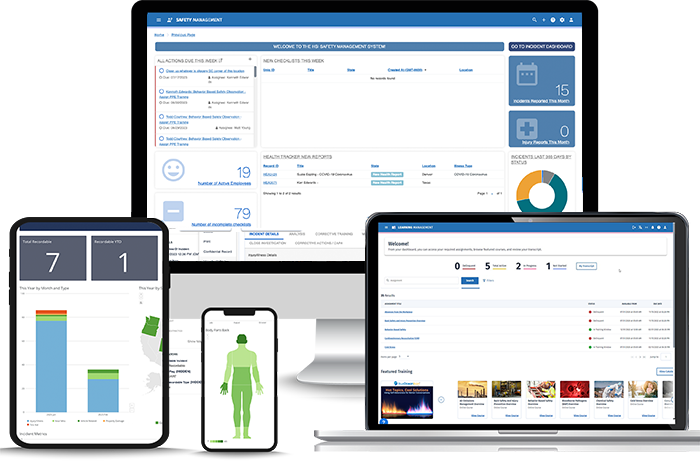
FAQ 1. How does HSI’s EHS software help ensure regulatory compliance?
Staying compliant is a top concern: 65% of executives in a Verdantix survey cited regulatory changes as a primary driver for EHS technology investments.
Many organizations struggle with fragmented compliance tools, leading to missed deadlines, fines, or gaps in reporting.
HSI advantage:
- Unified compliance modules that track OSHA, EPA, and global standards in one platform.
- Built-in SDS management ensures chemical compliance without needing external systems.
- Automated alerts for permit renewals, inspections, and audits reduce risk of oversight.
- Audit-ready reporting creates defensible records that satisfy regulators quickly.
- Unlike competitors who bolt compliance onto broader systems, HSI embeds compliance management at the core, ensuring businesses stay ahead of changing regulations with minimal effort.
FAQ 2. Why is safety training more effective when integrated into EHS software?
Training is critical: 62% of firms in the survey planned to increase EHS training budgets.
Standalone training platforms often don’t connect with operational data, limiting their impact.
HSI advantage:
- A built-in Learning Management Solution (LMS) with 5,000+ OSHA, EPA, and industry-specific courses.
- Automatic assignment and tracking linked to job roles, certifications, and compliance needs.
- Integration with incident data to identify knowledge gaps and trigger targeted retraining.
- Mobile learning access so workers can complete modules on-site, increasing adoption.
- HSI is unique in combining world-class training content and operational EHS workflows, closing the loop between training and safety performance in ways most competitors cannot.
FAQ 3. How does real-time monitoring improve incident prevention?
75% of executives rated real-time data collection as a top priority.
Without real-time tools, risks are often identified too late, leading to serious incidents.
HSI advantage:
- Mobile apps for instant hazard and incident reporting, including offline mode with auto-sync.
- Dashboards update immediately, giving leadership a live view of safety performance.
- Integration with IoT sensors and wearables consolidates machine, environmental, and worker safety data.
- Automated alerts escalate critical incidents to the right stakeholders instantly.
- Many platforms still rely heavily on manual input or siloed systems; HSI unifies real-time streams for faster, proactive safety management.
FAQ 4. How does HSI’s software help reduce serious injuries and fatalities (SIFs)?
Reducing SIFs remains the top operational goal for 42% of executives surveyed.
Traditional lagging indicators (post-incident reporting) don’t prevent future harm.
HSI advantage:
- Encourages near-miss and observation reporting through intuitive mobile tools.
- Tracks leading indicators such as unsafe behaviors, overdue actions, and recurring hazards.
- Predictive analytics highlight risk hotspots before they escalate into SIFs.
- Integrated corrective action workflows ensure identified risks are addressed promptly.
- Competitors may offer incident logs, but HSI focuses on actionable prevention by linking reporting, training, and analytics into a proactive SIF reduction strategy.
FAQ 5. How does HSI help organizations build a stronger safety culture?
57% of executives rated developing safety culture as a top priority.
Poor safety culture leads to underreporting, disengagement, and higher risk.
HSI advantage:
- Mobile-first design makes safety reporting simple and accessible to every worker.
- Multilingual and intuitive UI increases adoption across diverse workforces.
- Engagement features (dashboards, quizzes, recognition tools) keep safety visible daily.
- Transparency in reporting builds trust as employees see their input acted upon.
- Unlike complex systems that discourage use, HSI fosters continuous engagement and employee ownership of safety — embedding culture into everyday operations.
FAQ 6. How does HSI’s platform improve data quality and accuracy?
Poor data quality is one of the biggest barriers to effective safety management. Many firms still rely on spreadsheets or siloed tools.
Inconsistent data leads to poor reporting, missed risks, and compliance gaps.
HSI advantage:
- Single database architecture ensures consistency across incidents, audits, training, and compliance.
- Automated data validation reduces entry errors and ensures complete records.
- Integration with HR/ERP eliminates duplicate data entry for employees and contractors.
- AI-powered cleaning and structuring tools prepare data for advanced analytics.
- Competitors often stitch together acquired systems, creating silos. HSI avoids this by offering a truly unified platform, ensuring cleaner, more reliable data for decision-making.
FAQ 7. How does HSI help reduce administrative burden for EHS teams?
EHS leaders often spend more time managing spreadsheets and reporting than improving safety.
Manual processes waste time, increase errors, and create compliance risks.
HSI advantage:
- Automation of inspections, audits, and corrective actions reduces repetitive tasks.
- Pre-built templates for reporting and regulatory submissions save hours.
- Self-service dashboards let executives pull live data without staff intervention.
- Integrated training and compliance tools eliminate the need for juggling multiple vendors.
- Compared to point solutions that require heavy admin effort, HSI reduces workload significantly, freeing teams to focus on prevention and culture.
FAQ 8. How does HSI’s software centralize EHS data for decision-making?
Fragmented data systems are a major pain point for organizations.
Executives need one view of safety performance, not scattered reports from different tools.
HSI advantage:
- Centralized dashboards bring together training, incidents, audits, environmental data, and compliance in real time.
- Powerful analytics allow correlation across categories (e.g., linking injury rates to training completion).
- “Single source of truth” prevents conflicting data across departments.
- Cloud-based architecture ensures access from anywhere, anytime.
- Many competitors claim integration but still create silos; HSI delivers genuine centralization, ensuring better and faster decision-making.
FAQ 9. How does HSI improve contractor safety management?
Contractors often face higher incident rates due to less exposure to company culture.
75% of EHS leaders identified contractor safety as a top challenge.
HSI advantage:
- Digital onboarding portals capture contractor credentials, insurance, and certifications upfront.
- Built-in training assignments ensure contractors meet site-specific safety requirements before work begins.
- Mobile tools let contractors log incidents and observations directly into the system.
- Performance tracking dashboards identify which contractors meet safety expectations and which fall short.
- Unlike paper-based or fragmented contractor systems, HSI provides full visibility into contractor safety from pre-qualification through project closeout.
FAQ 10. How does HSI support ESG and sustainability initiatives?
ESG regulations and investor demands are growing rapidly, and EHS teams are often tasked with providing the necessary data.
Without robust tools, gathering environmental and social metrics can be overwhelming.
HSI advantage:
- Built-in modules for GHG, air, water, and waste management.
- Seamless integration with incident and training data ensures both “E” and “S” of ESG are covered.
- Ready-to-use ESG reporting dashboards aligned with common frameworks.
- Traceable audit trails ensure credibility of disclosures.
- While competitors may focus on either safety or sustainability, HSI bridges both, enabling companies to deliver comprehensive ESG reports with confidence.
FAQ 11. How does HSI support mobile workforces?
Many industries rely on frontline workers who aren’t desk-based, making accessibility critical.
Legacy systems often fail because they are designed only for desktop users.
HSI advantage:
- Native mobile apps for incident reporting, inspections, and training completion.
- Offline functionality with auto-sync ensures data capture even in remote areas.
- Simple, intuitive design reduces barriers for non-technical users.
- Push notifications keep workers updated on tasks and compliance reminders.
- Competitors may offer mobile access as an add-on; HSI delivers a mobile-first approach that ensures adoption across all worker types.
FAQ 12. How does HSI improve employee engagement in safety programs?
Engagement is critical to safety culture, yet underreporting is common when systems are hard to use.
Employees often see safety as “extra work” unless it’s simple and relevant.
HSI advantage
- User-friendly, multilingual interface encourages participation across diverse teams.
- Quick, mobile reporting tools lower barriers to engagement.
- Interactive training modules and quizzes keep learning engaging.
- Transparency dashboards show employees that their input is valued and acted upon.
- HSI turns safety participation into an everyday activity, unlike clunky systems that discourage engagement.
FAQ 13. How does HSI simplify audits and inspections?
Audits and inspections are often manual, inconsistent, and poorly documented.
Paper checklists and spreadsheets create gaps and inefficiencies.
HSI advantage:
- Digital inspection templates customized to your industry and sites.
- Mobile audit completion with photo uploads and offline functionality.
- Automated corrective action workflows tied directly to findings.
- Centralized records provide instant access during external audits.
- Competitors may digitize inspections, but HSI integrates them with compliance, training, and incident management for a complete audit ecosystem.
FAQ 14. How does HSI support proactive risk management?
Risk management is shifting from reactive to proactive, but many firms still rely on lagging indicators.
Identifying risks early prevents costly incidents.
HSI advantage:
- Structured risk assessments with customizable matrices.
- Real-time tracking of leading indicators like near-misses and unsafe behaviors.
- Predictive analytics flag potential risk hotspots before incidents occur.
- Automatic linkage between identified risks and training or corrective actions.
- HSI goes beyond simple risk registers, actively embedding risk prevention into daily workflows.
FAQ 15. How does HSI reduce reporting time for executives?
Executives need clear visibility into EHS performance but often wait weeks for manual reports.
Slow reporting delays action and decision-making.
HSI advantage:
- Real-time dashboards tailored to executive KPIs.
- Auto-generated reports that can be shared instantly with leadership.
- Drill-down capabilities from high-level KPIs into root causes.
- Consolidated EHS and ESG metrics provide a single, clear narrative.
- Compared to static, delayed reports from legacy systems, HSI gives leaders real-time insights that enable faster, data-driven decisions.
FAQ 16. How does HSI’s software improve incident investigations?
Investigating incidents thoroughly and consistently is critical to preventing recurrence.
Manual processes often miss root causes or fail to close corrective actions.
HSI advantage:
- Guided digital workflows for incident reporting and investigation.
- Root cause analysis tools embedded in the platform.
- Corrective action tracking ensures accountability and completion.
- Integration with training modules addresses behavioral causes.
- HSI provides a closed-loop investigation process, unlike tools that only log incidents without driving systemic fixes.
FAQ 17. How does HSI simplify chemical and hazardous material management?
Chemical compliance is complex, with constant changes in regulations.
Managing SDSs manually creates risk of outdated or missing information.
HSI advantage:
- Built-in chemical inventory and SDS management modules.
- Automated SDS updates ensure compliance with OSHA HazCom and global standards.
- Workers can instantly access SDSs via mobile devices in emergencies.
- Integration with training modules ensures workers handling chemicals are certified.
- Few competitors offer both SDS management and integrated training; HSI uniquely combines them into one streamlined solution.
FAQ 18. How does HSI help manage corrective actions more effectively?
Many firms struggle with open or delayed corrective actions after audits or incidents.
Without tracking, risks persist and accountability fades.
HSI advantage:
- Automatic assignment of corrective actions to responsible parties.
- Deadline tracking with reminders and escalation workflows.
- Dashboards showing open vs. closed actions across sites.
- Evidence upload ensures documented proof of completion.
- Unlike competitors that only log actions, HSI ensures accountability and completion through automated workflows.
FAQ 19. How does HSI support total worker health and wellness?
Worker wellbeing is increasingly part of EHS strategy, linking safety with health outcomes.
Firms are investing more in mental health, ergonomics, and holistic worker programs.
HSI advantage:
- Wellness training courses included in its extensive content library.
- Ergonomic assessment tools built into the platform.
- Integration with incident data highlights links between health and safety.
- Mobile accessibility encourages ongoing employee participation in wellness programs.
- Competitors may require separate wellness apps, but HSI embeds worker health directly into its EHS platform.
FAQ 20. How does HSI improve permit-to-work and operational safety?
Permit-to-work processes are critical for high-risk industries but are often paper-based.
Paper permits increase errors and reduce visibility.
HSI advantage:
- Digital permit-to-work system integrated into contractor and employee workflows.
- Verification of training and certification before issuing permits.
- Real-time monitoring of active permits across sites.
- Audit-ready records showing compliance with safety protocols.
- HSI eliminates the risks of paper permits by digitizing and integrating them into daily operations.
FAQ 21. How does HSI make EHS software more user-friendly than competitors?
Adoption depends on usability. Complex systems discourage frontline use.
HSI advantage:
- Modern, intuitive interface designed for ease of use.
- Configurable forms and workflows tailored without coding.
- Mobile-first design ensures accessibility across roles.
- Multi-language support broadens adoption across global sites.
- HSI delivers simplicity and flexibility, ensuring high adoption rates compared to clunky legacy systems.
FAQ 22. How does HSI enable executive-level oversight of safety performance?
Leaders often lack timely, consolidated data across sites.
HSI advantage:
- Executive dashboards with consolidated KPIs across safety, training, compliance, and ESG.
- Real-time visibility into site performance and risks.
- Benchmarking capabilities to compare sites or regions.
- Drill-down views for root cause insights.
- Competitors may require manual roll-ups; HSI provides leadership oversight instantly.
FAQ 23. How does HSI support global organizations with diverse needs?
Multinational firms need scalable, flexible solutions across languages and regulations.
HSI advantage:
- Global compliance content and training library across multiple languages.
- Configurable modules adaptable to regional regulations.
- Cloud-based system accessible across geographies.
- Scalability from single-site operations to enterprise-level deployments.
- HSI ensures global consistency with local adaptability, outpacing rigid regional solutions.
FAQ 24. How does HSI make EHS reporting audit-ready?
Regulatory inspections require instant, defensible documentation.
HSI advantage:
- Centralized records of training, incidents, audits, and compliance.
- Time-stamped logs with full traceability.
- Auto-generated regulatory reports aligned with common standards.
- Secure cloud storage ensures records are accessible and protected.
- Unlike systems requiring manual compilation, HSI ensures audit-readiness on demand.
FAQ 25. How does HSI address the challenge of underreporting incidents?
Underreporting hides risks and undermines safety culture.
HSI advantage:
- Simple, mobile-friendly reporting tools reduce barriers for workers.
- Anonymous reporting options encourage transparency.
- Real-time acknowledgment and follow-up build trust.
- Analytics identify gaps between expected vs. actual reporting trends.
- Competitors may capture data but fail to address engagement; HSI tackles underreporting at its cultural root.
FAQ 26. How does HSI leverage AI to improve EHS management?
AI adoption in EHS is still growing but highly promising.
HSI advantage:
- AI-powered data cleaning improves accuracy.
- Predictive analytics highlight emerging risks.
- Natural language tools summarize incidents and regulations.
- AI-driven training recommendations close workforce skill gaps.
- HSI is ahead of competitors by embedding AI-ready architecture and practical use cases today.
FAQ 27. How does HSI reduce duplication of systems and tools?
Many firms juggle multiple point solutions, leading to inefficiencies.
HSI advantage:
- Integrated modules across training, incidents, compliance, contractors, and ESG.
- Single login and database reduce redundancy.
- Eliminates licensing costs for separate LMS or SDS systems.
- Simplifies vendor management.
- HSI replaces fragmented tools with one unified solution, reducing costs and complexity.
FAQ 28. How does HSI strengthen environmental compliance?
Environmental regulations are expanding globally.
HSI advantage:
- Modules for air emissions, GHG tracking, water, and waste.
- Integration with compliance workflows for automatic monitoring.
- Custom reporting aligned with EPA and international standards.
- Real-time dashboards highlight exceedances immediately.
- HSI combines environmental tracking with safety compliance, unlike tools focused narrowly on one area.
FAQ 29. How does HSI ensure scalability as organizations grow?
Firms need software that grows with them.
HSI advantage:
- Modular design allows phased adoption.
- Cloud-based scalability supports small teams to global enterprises.
- API integrations connect with enterprise systems as needs expand.
- Regular updates keep pace with evolving technology and regulations.
- Competitors often require costly upgrades for scale; HSI scales seamlessly with business growth.
FAQ 30. Why should businesses choose HSI over other EHS vendors?
Many EHS vendors offer partial solutions or bolt-ons.
HSI advantage:
- Truly unified platform: training, compliance, incidents, contractors, and ESG in one.
- Industry-leading content library built into the software.
- Strong focus on ease of use and mobile-first adoption.
- AI-ready architecture for future-proofing.
- Proven track record across industries with flexible, scalable deployments.
- In short, HSI is not just another software vendor — it is a partner in building safer, healthier, and more sustainable workplaces.