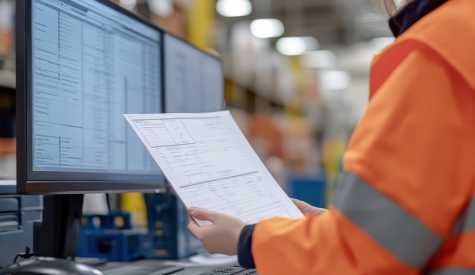
How EHS Software Uses AI to Turn Incidents into Corrective Action
Key Takeaway
AI turns scattered incident data into clear, connected action. It links reports, hazards, and training to reveal patterns faster. This helps teams choose stronger fixes based on real risk. Using EHS software also cuts out manual cross-checking, so teams can spend more time preventing incidents.
Why Does Corrective Action Break Down After Incident Reporting?
Most teams don’t struggle to document incidents. The real issue starts after the report is filed, when teams need to connect that single event to everything else that could explain it.
That process still relies on manual cross-referencing. A typical workflow looks like this:
Review the incident report
Check past incident logs
Scan hazard reports for similar issues
Verify who completed related training
Email teams to confirm if corrective actions were closed
Each step adds friction. Over time, that friction slows response, delays decisions, and makes it harder to see the full picture behind the incident.
This is where many corrective actions lose strength. Teams may fix what’s visible, but miss the deeper cause because the data needed to connect the dots in different places.
OSHA’s incident investigation guidance reinforces this point. Effective investigations must address root causes, not just immediate events. It also notes that contributing factors often come from gaps in equipment, procedures, training, or broader safety programs, which are rarely captured in one record.
AI helps close that gap. It connects the records teams already keep, so they can move faster from a single report to a clearer understanding of what needs to change.
How Does AI Connect Incident Reports, Hazards, and Corrective Actions?
AI works best when it can read structured safety data and connect related information quickly. Instead of reviewing one record at a time, it looks across multiple data sources at once and brings them together in a single view.
In practice, that means it can analyze:
Incident reports
Near-miss records
Inspection findings
Recurring hazards
Past corrective actions
Employee training history
Once those data points connect, patterns start to surface. Relationships that would take hours to find manually become clear in seconds.
You start to see links like:
A hand injury at one site tied to earlier near misses at another location
A forklift incident connected to repeated inspection notes about traffic flow
A PPE issue traced back to gaps in task-specific training for a small group
These connections often stay hidden when systems don’t talk to each other. AI brings those records together, so teams can see the full picture without digging through multiple sources. Once those connections are visible, the focus shifts from finding patterns to acting on them.
How Can AI Improve Corrective Action Decisions?
Identifying the cause of an incident is only part of the job. The real impact comes from choosing a corrective action that actually reduces risk, not just one that feels easy to implement.
This is where many programs fall short. Teams often default to reminders, refresher talks, or general training because they are quick to assign and easy to track, even when they don’t address the root of the problem.
The Hierarchy of Controls offers a clearer path. It ranks control methods based on effectiveness, with elimination, substitution, and engineering controls at the top because they reduce risk without relying on perfect human behavior.
That guidance should shape how corrective actions are selected. Stronger recommendations focus on removing or redesigning the hazard, not just managing how people interact with it.
An unguarded machine points to installing proper guarding or redesigning the setup
Repeated slip hazards may call for improved drainage, flooring, or workflow changes
Recurring exposure issues may require process changes, not just reminders
This approach aligns with OSHA’s hazard prevention and control guidance, which emphasizes minimizing or eliminating hazards to prevent incidents. AI adds real value when it supports this level of decision-making. It helps teams move beyond surface-level fixes and choose actions that address the actual source of risk.
How Does AI Match Incident Findings to the Right Safety Training?
Training plays a key role in prevention, but it only works when it matches the actual hazard. When training feels generic or disconnected from daily tasks, it’s less likely to change behavior where it counts.
OSHA reinforces this idea by tying training requirements directly to specific hazards and job tasks:
The Hazard Communication standard (29 CFR 1910.1200) requires training when workers are exposed to new chemical hazards
The lockout/tagout standard (29 CFR 1910.147) requires training on the exact procedures used to control hazardous energy
The PPE standard (29 CFR 1910.132) requires workers to demonstrate they can properly use the equipment required for their specific tasks
Each of these rules follows the same principle. Training is not meant to be broad or generic, it must reflect the actual hazards workers face and the tasks they perform.
AI helps close that gap by linking incident details directly to the right training. Instead of assigning broad courses, teams can match training to the specific hazard involved.
A chemical exposure calls for hazard communication training tied to that substance
A lockout failure points to task-specific energy control training
A lifting injury highlights the need for ergonomic or material handling training
When training reflects real hazards, it becomes part of the solution instead of a routine step. The next question is how this all plays out in day-to-day operations.
What Does an AI-Driven Incident Response Workflow Look Like?
A technician suffers a hand injury while servicing a packaging line. The incident gets logged, reviewed, and closed out with a quick investigation and a general training assignment. On paper, the process is complete.
But the story doesn’t stop there.
When AI connects the surrounding data, a different picture starts to form. The same equipment shows up in prior near-miss reports. Inspection notes from the past quarter mention guarding concerns. Another facility flagged a similar exposure point but never escalated it.
Training records add another layer. The team completed general safety courses, but no one received a task-specific lockout refresher tied to that maintenance activity.
Now the response shifts. Instead of reacting to a single event, the team can act on a pattern that was already forming.
They can redesign guarding where it’s needed, adjust the maintenance procedure, review similar equipment across sites, and assign targeted training to the right group. Each step ties back to what actually caused the risk.
That’s the difference that matters. One approach closes the incident. The other reduces the chance it happens again.
How Does HSI Help Teams Turn Incident Data Into Action?
Most safety teams don’t lack data. They lack a clear way to connect it and act on it before the next incident happens.
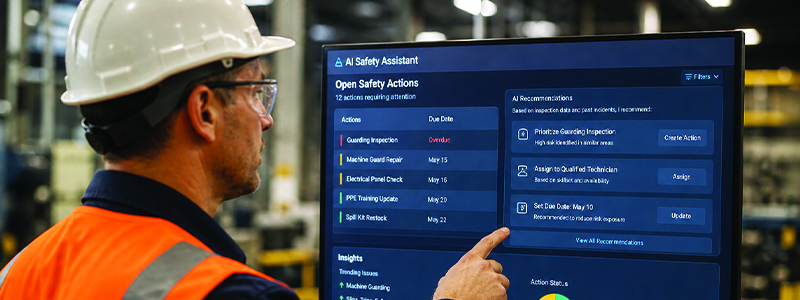
HSI brings everything into one EHS software, so teams can move faster and make better decisions. Its platform combines safety training, EHS management, compliance tracking, and incident data into a single system, with Sky built in as an AI-powered safety assistant.
Sky analyzes your safety data in context and helps answer the questions that usually take hours to piece together:
Where are repeat hazards showing up across sites and teams
What corrective actions make sense based on the actual cause
Which employees need targeted training, and on what topics
What patterns are forming before they lead to another incident
Instead of jumping between systems, teams can work from one connected view. Sky surfaces patterns, highlights risks, and recommends next steps, so corrective actions are faster, clearer, and more effective.
The result is simple. Less time chasing records, fewer missed connections, and more focus on preventing incidents before they happen.
AI closes the gap between incident documentation and effective corrective action by connecting records that would otherwise require hours of manual cross-referencing. The organizations that see the clearest results are the ones using EHS software platforms where incident management, hazard reporting, corrective action, and training all operate in a single connected system because that is the data the AI needs to surface meaningful patterns and recommend evidence-backed fixes.
For teams evaluating EHS software for incident tracking and corrective action, the key questions are:
- Does the platform connect incident data to training records automatically?
- Can AI surface root cause patterns across sites?
- And can your team manage and update the system without ongoing vendor support?
See how HSI's EHS platform compares to VelocityEHS, Intelex, Enablon, and Benchmark Gensuite, or schedule a demo to see the incident and corrective action workflow in practice.
FAQ
Does the platform automatically connect incident data to training records?
Yes. The platform integrates incident reports, hazard data, and training records in one system. Our purpose-built AI specifically for EHS leaders automatically links incidents to relevant training, identifying where gaps exist and recommending targeted learning for specific roles, teams, or locations.
Can AI surface root cause patterns across sites?
Yes. Our advanced AI analyzes data across incidents, near misses, inspections, and audits to identify root cause patterns at scale. It highlights recurring risks across sites, job functions, and tasks, helping EHS teams move beyond isolated events to enterprise-wide prevention strategies.
Can our team manage and update the system without ongoing vendor support?
Yes. The platform is designed for EHS teams to manage independently. Administrators can update workflows, training assignments, forms, and reporting without relying on vendor support, giving teams the flexibility to adapt quickly as regulations, risks, and operations evolve.
What is the biggest challenge in moving from incident reports to corrective action?
The biggest challenge is disconnected data. Incident reports, hazard logs, and training records often live in separate systems, which forces teams to manually cross-reference information. Modern EHS software helps centralize this data, but without AI, teams still struggle to connect insights quickly. This slows response time and makes it harder to identify root causes and repeat risks.
How does AI improve incident investigation in safety programs?
AI reviews incident reports, near misses, inspections, and training records together. It connects related events and highlights patterns across locations, job roles, and tasks. This helps safety teams identify root causes faster and focus on prevention instead of manual review.
How does AI help identify repeat safety risks?
AI scans historical safety data to detect trends that are easy to miss. It can flag recurring hazards, repeated injuries, or gaps in controls across sites. This allows teams to act earlier and reduce the chance of similar incidents happening again.
How can AI support better corrective actions?
AI recommends corrective actions based on incident data and safety best practices. It can suggest stronger controls, like engineering changes, instead of defaulting to retraining. This helps organizations address root causes and reduce risk more effectively.
How does AI connect incident data to employee training?
AI links incident findings to specific training needs. It can identify which employees or teams need targeted training based on the hazard involved. This ensures training aligns with real risks and helps prevent future incidents.
Related Articles
AI-Powered Corrective Training: Respond Faster and Smarter to Workplace Incidents
AI-Powered Corrective Training for Workplace Incidents
Workplace Safety

AI in Safety: Spot Hidden Hazards Before They Become Accidents
AI in Hazard Detection: Preventing Accidents Before They Happen
EHS Environmental, Health & Safety

When Corrective Actions Stall: Identifying and Removing Workflow Bottlenecks
End Workflow Bottlenecks in Corrective Actions
Workplace Safety