How AI Image Hazard Recognition Is Changing the Way EHS Teams Catch Hazards
Key Takeaway
- AI helps identify hazards faster by analyzing photos and detecting risks that might otherwise be missed during inspections.
- Advanced AI tools connect hazards to OSHA standards, giving EHS teams immediate compliance context and actionable guidance.
- The greatest value comes from workflow integration, where identified hazards automatically trigger corrective actions, training, and follow-up activities.
- EHS is becoming more proactive, with AI and computer vision helping organizations identify and address risks before they lead to incidents, near misses, or violations.
Spot Risks Faster with AI-Powered Hazard Recognition
Most hazard reporting programs share the same weak link: someone has to notice the hazard, decide it's worth reporting, then go fill out a form. Every one of those steps is a place where a real risk can quietly fall through the cracks.
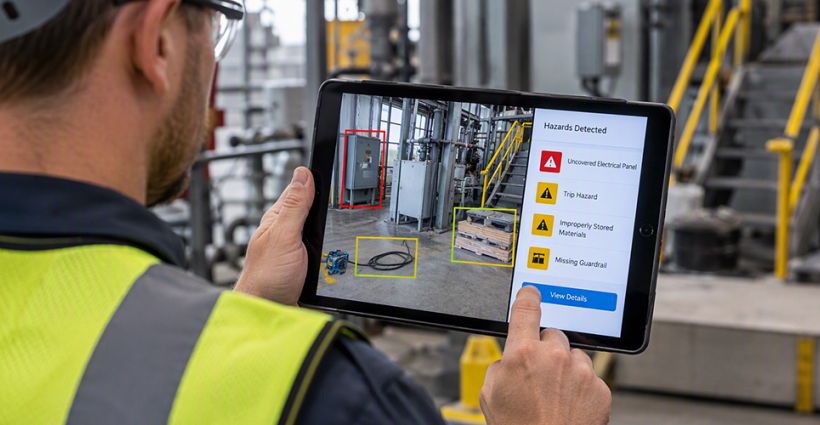
AI image hazard recognition removes the first two steps from that chain. Instead of waiting for a trained eye to catch an unguarded machine or a missing barrier, a photo taken on a phone can be analyzed instantly, flagging what's actually in the frame: an unguarded pinch point, a worker positioned too close to hazardous energy, a missing lockout tag.
From a Photo to a Regulatory Reference
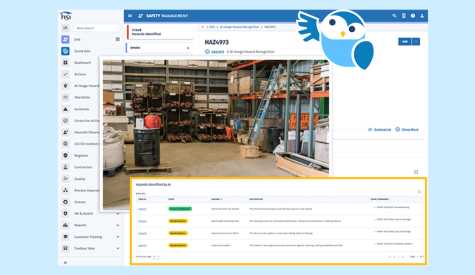
The more useful versions of this technology don't stop at "here's a risk." They tie what they see to specific standards. A photo of an exposed piping and valve assembly, for example, can come back with direct citations attached to the findings, such as OSHA 1910.212(a)(1) on machine guarding, 1910.147(a)(1) on lockout/tagout, 1910.119(a)(1) on process safety management for hazardous chemicals.. That action turns a vague "this looks risky" into something an EHS team can act on immediately, with the regulatory context already built in.
Why This Matters More Than Organizations Realize
EHS professionals already know hazards go underreported. Filling out a report takes time, and a lot of small, easy-to-miss risks never get flagged because nobody happened to notice them at the right moment. AI recognition doesn't replace the human eye – it extends it. A supervisor walking a site can photograph anything that looks off without already knowing which OSHA standard it might violate. AI fills that knowledge gap on the spot.
The Finding Doesn't Stop at "Flagged"
What makes this process genuinely useful, rather than just a novelty, is what happens after the hazard is identified. A flagged risk should flow directly into a structured hazard or observation report, not sit in a separate app disconnected from the rest of the safety program. From there, it can be assigned a corrective action, linked to training if the root cause points to a knowledge gap, or become the real-world example behind a toolbox talk or safety announcement that week.
That's the difference between a hazard recognition feature and a hazard recognition program. The photo is the easy part. Making sure it leads somewhere is what actually prevents an incident.
Where Hazard Recognition is Headed
This isn't a fringe trend. Industry analysts covering the EHS technology market have been tracking this shift closely. They describe AI's role as moving through stages, from assistive tools that support a person's judgment, toward more autonomous systems, and what's increasingly called agentic AI. Early applications such as automated incident analysis and compliance monitoring are being joined by more advanced use cases like computer vision for hazard detection and predictive risk forecasting, all aimed at moving organizations from reacting to compliance problems toward preventing them in the first place.
Computer vision, which uses cameras paired with AI to analyze a scene in real time, is well past the pilot stage. Recent industry research found that more than half of firms had either fully or partially rolled out computer vision and video analytics, with plans to expand that use further. Analyst benchmarks now compare vendors specifically on safety-relevant capabilities like PPE detection and unsafe behavior recognition, a sign that this category has moved from novelty to something treated as a standard part of the EHS technology stack.
The direction is consistent: EHS teams are moving from reactive documentation toward tools that catch risk at the moment it's visible, not after it's already caused a near miss or worse. AI image hazard recognition is one entry point into that shift. As more organizations connect it to their broader EHS workflows, it stops being an add-on feature and starts being the front door to the entire safety program.
Related Articles
How Conversational AI Changes the Way Safety Leaders Use EHS Software
Discover how conversational AI helps safety leaders interact with EHS systems by answering questions about incidents,...
Workplace Safety
Beyond Dashboards: How AI Is Changing the Future of EHS
Learn how modern EHS software uses AI to connect hazard reporting, incident data, corrective actions, and training.
Workplace Safety

How AI Detects Safety Hazards from Job Site Photos
How AI Image Hazard Recognition Works in EHS
Industrial Skills