Why Communication Belongs at the Center of Leadership
Communication skills training is at the core of leadership development. To be effective in a digital era which requires clarity, adaptability, and trust, L&D leaders must prioritize communication training first and foremost.
Clear communication is important enough to be taught, practiced, reinforced, and supported alongside other core leadership skills. This article discusses the pros and cons of the different ways business leaders communicate: verbally, nonverbally, visually, and in writing.
Here are several communication best practices:
- Consistency and visibility
- Audience awareness
- Strategic communication channel choice
HSI helps train leaders to become more effective communicators, build productive, resourceful teams, and achieve career and business success.
A lack of effective leadership communication skills leads to missed deadlines, misaligned expectations, organizational goals and shared vision, strained working relationships, and employee disengagement.
A leader’s communication style can be ineffective because of unclear expectations, mixed messages are sent, or inconsistent communication channels. When any of those happen, even well-designed business strategies lose effectiveness. For L&D leaders, this is a critical insight. Having strong communication skills isn’t just a leadership trait but a soft skill that directly drives alignment, performance, and trust.
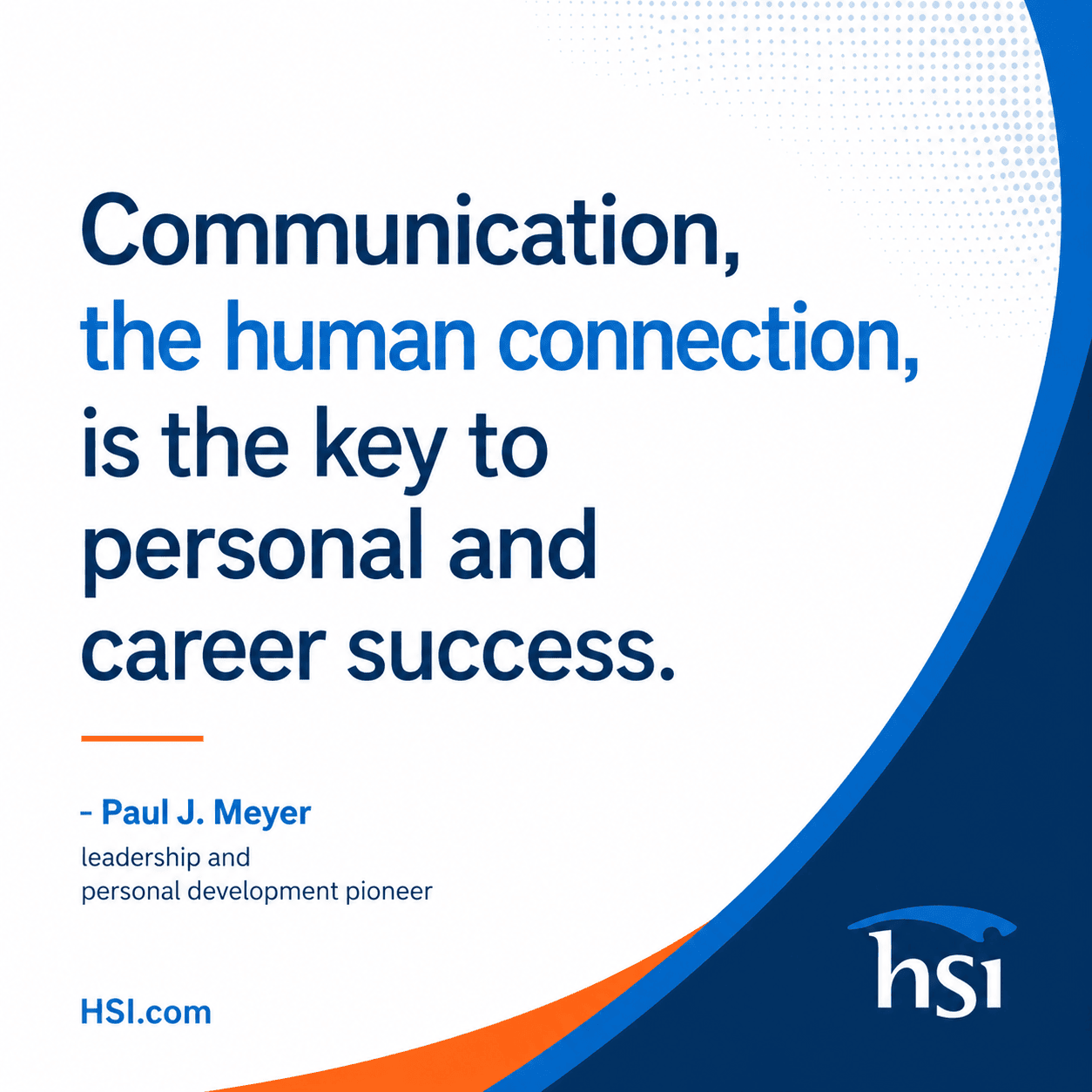
Only about one in five employees strongly agree that their performance is managed in a way that motivates them, according to Gallup research. This reflects poor communication by leaders in communicating expectations, priorities, and providing regular feedback.
Does your organization have a culture of transparency where open dialogue is prevalent? Unfortunately, many treat the art of communication as a given rather than intentionally developing it through proper training.
As L&D leaders know, effective communication skills do not magically improve with experience or a new promotion. Clear communication must be practiced, reinforced, and supported like other core leadership skills.
Strong communication skills in the business environment are about making deliberate choices, such as choosing the right message, whether it is communicated verbally, visually, or nonverbally, and determining the right communication channel for the audience. Successful leaders communicate in ways that build understanding, trust, and a shared commitment.
"With public sentiment, nothing can fail; without it nothing can succeed.” — Abraham Lincoln, 16th President
The Pros and Cons of Different Ways Business Leaders Communicate
Leadership communication training often begins with understanding how messages are delivered and received, and the pros and cons of each.
#1: Verbal communication: This type of communication occurs most often in one-on-one conversations, team meetings, and formal presentations. Precise word choice and pacing are more important than many business leaders realize. Recent research shows that simplifying language improves comprehension and decision-making, especially in fast-paced and demanding situations.
#2: Nonverbal communication. Nonverbal cues, like body language, eye contact, tone, volume, and pace, shape how messages are interpreted and often carry more impact than other forms of communication. The message, as well as trust, is lost when verbal and nonverbal cues conflict. Leaders can’t state that they want a collaborative environment while their body language (folded arms and lack of eye contact) says the opposite when team members share new ideas.
#3. Visual communication: This approach plays a growing, pivotal role, especially in remote and hybrid work environments. A phone call doesn’t show leaders’ visual cues, such as hand gestures, making it less effective than video conferencing for detailed and complex discussions. Media richness theory (MRT) explains that communication works best when the medium provides enough social cues to match the complexity of the message.
#4. Written communication: This interaction style creates permanence. Emails, instant messages, and documents often remain long after they’re sent. Leaders should make sure their written messages are not emotionally reactive. These types of responses may cause unnecessary escalation and misunderstandings, especially in fast-paced digital environments. The leader’s ability to pause and reflect before responding is a very important leadership habit.
Leadership Communication That’s Consistent and Visible
Business leaders are communicating all the time, even when they don’t speak. Tone in meetings, posture in virtual meetings, word choice in emails, and response speed all send messages to employees. The employees interpret these messages to set priorities, and understand expectations. If the messages are clear and concise, stronger relationships form, trust is built, and credibility is established. Employee engagement, job satisfaction, and retention naturally occur as transparent communication, mutual respect, and a supportive environment evolve.
Gallup's 2024 State of the Global Workplace Report shows that managers are the greatest influence on employee engagement. This shows that effective leadership communication skills are among the most powerful drivers of employees’ motivation and sense of purpose.
This is why workplace communication skills are foundational to leadership and organizational success. A common goal for all L&D teams must be to help business leaders become more intentional about the messages they send, both spoken and unspoken.
Separating Great Leaders from Average Ones with Audience Awareness
One of the most common leadership communication gaps is failing to recognize and acknowledge who the audience is. Great leaders communicate with executives, direct reports, team members, and cross-functional and external stakeholders, in different tones, levels of formalities, and detail.
A message that works well with peers may fail to resonate with senior business leaders. The best leaders pause before communicating to acknowledge who they are addressing, the information to convey, and how their relationship with the audience shapes the message. This pause alone can significantly improve alignment and reduce unnecessary misunderstandings.
The Leader’s Communication Channel: A Strategic Decision
Today’s business leaders navigate email, instant messaging, phone calls, virtual meetings, and in-person conversations most likely within the same workday.
Each communication channel serves a unique purpose. Email supports documentation,; instant messaging allows for a speedy response,; phone calls create shared understanding,; virtual meetings build connection, and in-person conversations create space for sensitive or complex discussions.
When leaders make poor choices about communication channels, they contribute to employee misalignment and rework. Leadership communication training can help leaders move beyond habit and convenience and choose communication channels intentionally based upon their audience and the message’s context.
Why Communication Skills Training Belongs at the Core of Leadership Development
Clear communication leads to effective strategy and execution. When business leaders communicate clearly and intentionally, team members align faster, collaboration improves, trust grows, and job performance excels. Gallup’s research shows that highly engaged teams deliver significantly higher profitability, confirming the importance of effective leadership communication skills. Setting clear expectations and providing ongoing feedback directly influence employee engagement.
For L&D leaders, communication skills training allows learners to be the most effective leaders in the fast-paced digital era, where clarity, adaptability, and trust are of utmost importance for success.
"Communication is one of the most important skills you require for a successful life.” — Catherine Pulsifer, personal development writer
HSI Can Help
Being a good communicator is critical. Communication is the heart of soft skills. HSI offers employees a library of off-the-shelf content that puts related microlearning video training courses at the employees’ fingertips.
HSI provides the most comprehensive and useful eLearning resources for forward-thinking professionals.
- HSI’s communication skills topics help employees develop effective communication skills in key areas such as assertive verbal skills, active listening, nonverbal communication, email etiquette, and more invaluable leadership skills.
- The leadership training covers topics such as DISC leading skills, leading with authenticity, mentoring, succession planning, transformational leadership, and much more, including a wide range of soft skills.
If you would like to learn more about HSI, request a consultation.
Related Articles
Communication Skills
Online communication training for your entire workplace. Develop more effective communication habits with our online,...
Employee Training & Development

6 Ways to Improve Organizational Communication—and Your Bottom Line—with AI
Learn ways to collaborate with AI technology to improve organizational communication and the organization's bottom line.
Employee Training & Development

Conquering Feedback: Strategies to Level-Up Workplace Feedback
Download our white paper to gain insights into embracing employee feedback, the psychology of feedback, and discover...
Resources