Qualified Electric Workers
Are Your Qualified Electric Workers OSHA-Compliant?
The OSHA standards relating to qualified electric workers (QEW) can be confusing.
- How do you identify which workers are QEWs?
- What training do you need to give them?
- What do you need to do for employees who work around electrical equipment but are not QEWs?
- How do you even know if the OSHA standards apply to you?

We’ve outlined everything you need to know to stay compliant with OSHA standards
1910.332 and 1910.333 for non-utility industries. Not sure if those standards apply to you? If you can answer “yes” to any of the questions below, you need to comply with these standards.
- Do you or any workers you supervise work in a manufacturing environment where you’re exposed to electrical hazards? (OSHA defines an electrical hazard as a serious workplace hazard that exposes workers to burns, electrocution, shock, arc flash/arc blast, fire, or explosions)
- Are you responsible for conducting, coordinating, or overseeing maintenance on electrical equipment?
- Do you or your workers work around electrical equipment even in a non-manufacturing environment?
OSHA standards 1910.332 and 1910.333 and the Manufacturing Industry
If you’re not familiar with the standards, 1910.332 covers the training requirements OSHA has established to ensure those working near or on electrical equipment have the required training. 1910.333 covers safe work practices and goes into detail about what you can do to keep your workers safe by mitigating any hazards that might occur if they work on or around electrical equipment.
Why are these standards important?
The reality is most accidents occur because of unsafe equipment or installation, particularly electrical equipment, an unsafe environment, or unsafe work practices. Data from the U.S. Department of Health and Human Resources shows that more than 400 workplace electrocutions and 4,000 electrical accidents occur each year. According to OSHA, electrocution is the sixth highest cause of workplace deaths in America. OSHA’s most cited issue on these standards is the inability to control hazardous energy or the failure of the lockout/tagout process.
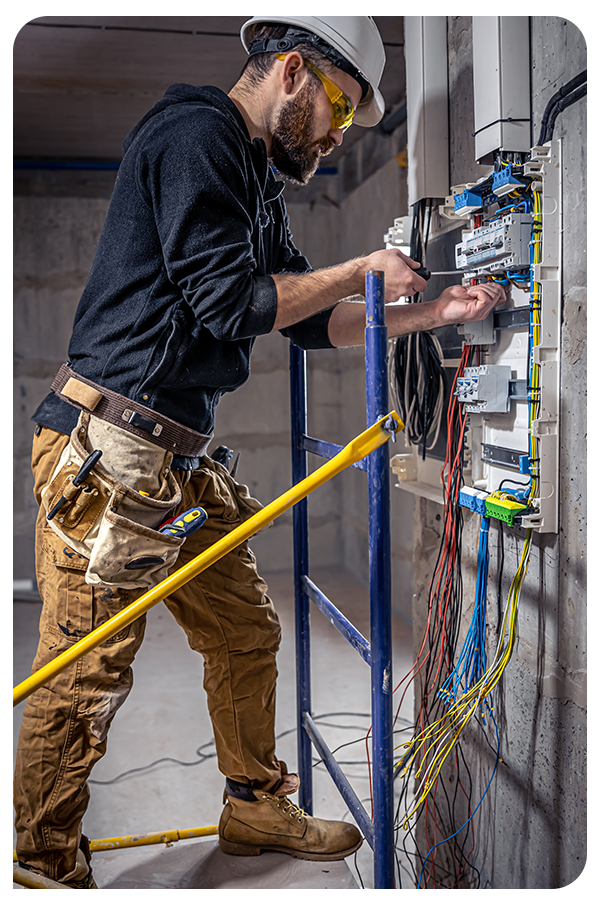
HSI Personal Story
Electrical accidents can happen to anyone. An HSI subject matter expert shares his experience as a maintenance electrician.
One of my memorable early learning moments was when I was following the lockout/tagout procedure for a pump. I had to test the pump, which meant I had to lock it and tag it out. I followed the procedure to tag the pump. I tested the lines coming in, tested inside the controller, then started my work. What I didn’t know was this pump was interlocked with another one, meaning if pump one stopped, pump two would start.
That meant wires coming from the other pump were still fed at 480 volts into the controller I was working on, which I found out unexpectedly. It was a failure on my part, due to lack of knowledge and improper labeling. Because my tagout was checked by someone else, it was also a failure on their part. So, even if you believe you’re following the right steps, you always need to go one step further – make training important.
This story demonstrates that even if you are trained, accidents do happen. Training can’t prevent all accidents, but it can help mitigate and reduce the risks of accidents. Remember, you still need to account for the human factor.
What is a Qualified Electric Worker (QEW)?
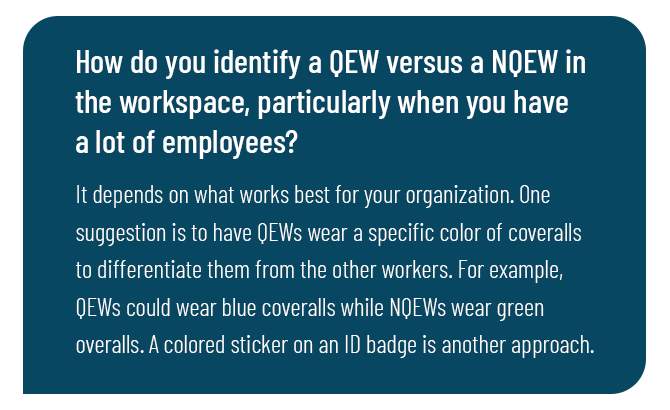
A QEW is trained and knowledgeable about tasks performed on electrical equipment, including safety measures, protective equipment, and task proficiency. OSHA 1910.332 requires QEWs be trained and familiar with 1910.331 through 1910.335. QEWs should have additional training to perform work on energized equipment and carry out the tasks associated with their job. They can also train unqualified electrical workers to provide additional QEWs down the road.
QEWs are the workers exposed to parts of electric circuits operating at 50 volts or greater to ground. These workers’ supervisors are also QEWs. We’ve provided a list of OSHA’s high-risk occupations where training on these standards is required. The list isn’t all-inclusive – other occupations may have QEWs. The question is whether the worker is exposed to electric circuits at 50 volts or more to ground.

OSHA High Risk Occupations:
- Blue-collar supervisors and managers
- Electrical and electronic engineers
- Electrical and electronic equipment assemblers
- Electrical and electronic technicians
- Electricians
- Industrial machine operators
- Material handling equipment operators
- Mechanics and maintenance workers
- Painters
- Riggers and roustabouts
- Stationary engineers
- Welders
- Plant manager
- Facilities maintenance
- Line worker
- Power plant operator
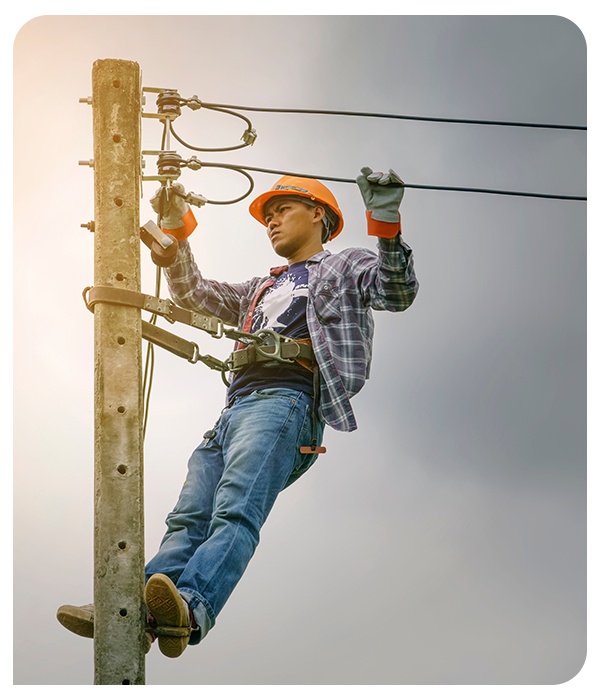
What is an Applicable Non-QEW Electric Worker (NQEW)?
While not an OSHA term, we define NQEWs as workers in your environment who cannot perform work on any electrical equipment above 50 volts. Because of the nature of the workspace, they may still be around the risks, but cannot, under any circumstances, work on equipment rated at 50 volts or more to ground.
The standard does require training for NQEWs, but the level is a little different. As an employer, you need to identify the risks that apply to them and ensure they operate in a safe manner. Your challenge is identifying those risks to provide the proper training.
NQEWs must know the risks associated with being around energized equipment. They should know how to protect themselves and others when working around electricity, even though they can’t maintain the specific equipment themselves. You should train NQEWs properly on personal protection equipment, electrical hazards, and warning signs and barriers around equipment.
How Do You Develop a Training Program?
At a high level, you need a structured program for both QEWs and NQUEWs. Begin with your job descriptions, which should tell workers how they are accountable to the OSHA requirements.
To ensure you address all critical tasks in your training, include these tasks in detailed job descriptions. From those descriptions, perform a job task analysis and create a job performance matrix to detail each task a worker performs. Consider industry mishaps and lessons learned to help identify your training needs.
Once you complete your matrix, assess your workers’ skills and knowledge through an assessment. Have workers demonstrate a skill and administer a quiz for knowledge. Using those assessment tools, you can evaluate your workers’ competence to perform the jobs. You don’t want to find out a worker has forgotten their training when something significant happens, particularly a high-risk event that doesn’t happen often. Periodic evaluations identify areas for retraining.
Once you’ve determined competency, periodically evaluate performance, particularly for high risk tasks.
Next, identify and organize your training resources, both internal and external. Many vendors offer generic training to provide workers a foundation in the skills and knowledge they need. Carefully evaluate any potential third-party vendors. Our white paper, 6 Ways Off-the-Shelf Training Brings Value, offers tips on how to ensure off-the-shelf training works for you. In addition, you can develop your own training – online, instructor-led, or on-the-job.
If you do experience an event, one of the first things OSHA will review is your training. Having a structured training plan where the training ties to the tasks will help you demonstrate you’ve mitigated risks to your workers. It’s important to remember that OSHA requirements don’t establish qualifications. It’s up to you as the employer to identify risks and determine at what point a worker is qualified to assume those risks.

How Do You Create a Safety Culture?
The first step in creating a safety culture is empowering all workers to speak up when they see unsafe activity or potential issues. Workers should be able to call a timeout when they believe something isn’t right or a situation is unsafe, regardless of their level. Making sure everyone at each level takes ownership of your safety program is key to its success.
Your safety program should include the needed information to demonstrate to senior managers areas to enhance and improve safety. Information about unsafe conditions, near misses, and accidents is the basis for developing training. This information can highlight areas where an event could happen – not necessarily because someone is doing something wrong, but because they didn’t have the correct training. If your organization isn’t tracking that information, it’s time to start.
You can also use the safety pyramid to estimate the relative safety of your work environment and help promote a safety culture. If unsafe acts and near misses are reported and tracked, the organization can monitor the progress of its safety efforts. And, if workers see it as a way to make the workplace safer instead of punishing them for reporting an issue, you’ll be well on your way to a strong training program. Take this short QEW Training Assessment.
Take the Assessment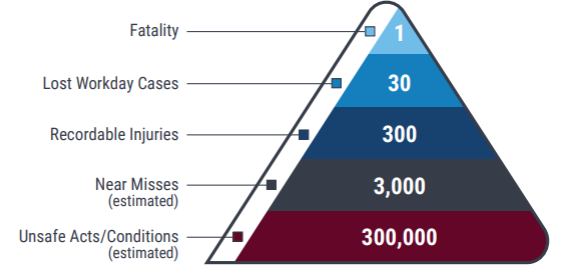
Real Life Scenarios
In conversations with clients, we’ve found at least half have experienced an event and another quarter have had a near miss. That’s 75% of our clients, which highlights the importance of properly training workers. Issues will happen, so the goal is to reduce the likelihood and severity. We have four scenarios we pulled from the OSHA website. In all four scenarios, a worker was killed on the job. These scenarios highlight how any tasks, regardless of how simple, can result in an injury or fatality
Scenario 1
At 1:00 p.m. on July 24, 2019, an employee was energizing a portable heater to verify repairs had corrected reported issues with the machine. The employee contacted live 480 V terminal screws inside the machine’s control compartment and was killed by electrocution
Scenario 2
On July 28, 2021, an employee was performing an HVAC filter change when a coworker found him unresponsive in the control room. The injured employee had no evidence of trauma or electrical shock, but had complained of chest pain to a coworker prior to being discovered. The employee died of a suspected heart attack
Scenario 3
At 8:15 a.m. on June 12, 2021, an employee was standing on a fiberglass ladder replacing an overhead lighting fixture in a sales area. The employee touched a live electrical part, was shocked, and fell off the ladder to the floor below. The employee suffered a head injury and died
Outcome
The employer received 40 ‘serious violation’ citations and nine ‘other than serious’ violation citations resulting in more than $236,000 in fines from OSHA, in addition to the emotional costs of losing an employee in a fatal accident on the job. This scenario is a good example of an event that could have been mitigated by training
Outcome
Injuries from electrical shock are not always immediately or readily apparent. While it’s impossible to determine exactly what happened in this scenario, if the employee had been trained to immediately notify his supervisor and call for help after a shock, it could
Outcome
As noted on the previous scenario, injuries and fatalities from electrical shock are not necessarily from the shock itself. Training questions to consider are should the worker have known the circuits were live? Should someone have raised the question about the possibility of a live circuit? Should there have been a pre-job briefing, additional safety equipment, or perhaps a second worker?
Resources
Here are some resources you should be familiar with.
- Fatal electrical injuries at work: NFPA - Fatal electrical injuries at work
- OSHA Fatality Inspection Data/Occupational Safety and Health Administration: Fatality Inspection Data | Occupational Safety and Health Administration (osha.gov)
- HSI QEW course list: IS_Qualified Electrical Worker Course List Manufacturing.pdf (hsi.com)
- QEW Training Assessment
Reviewing these resources should give you some ideas of similar risks your organization may have and how you can prevent them. The data from OSHA and NFPA will help you learn without incurring the pain of experiencing events at your organization