How AI is Transforming Safety: From Finding Hazards to Preventing Incidents
AI helps safety teams identify hazards faster, improve corrective actions, and target training based on real risk. It strengthens existing safety programs by turning data into clear next steps. As AI advances, it will connect safety processes more closely, but employers still hold responsibility for compliance and oversight. The future of safety management depends on using AI to support better decisions, not replace them.
How Does AI Help Identify Workplace Hazards Earlier?
Hazard recognition sits at the center of any effective safety program. OSHA’s Recommended Practices for Safety and Health Programs makes it clear that employers need to identify hazards, investigate near misses, and train workers to recognize risk early. The challenge is not knowing this, it’s doing it consistently across busy, complex worksites.
AI helps close that gap by making hazard identification faster and more consistent in day-to-day operations. Instead of relying only on scheduled inspections or manual reviews, teams can use AI to continuously analyze what’s happening in the field and surface risks as they appear.
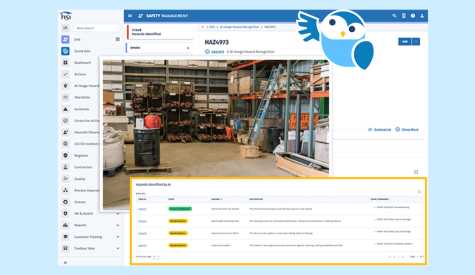
One of the most practical examples is image-based hazard recognition. Workers can upload photos from a jobsite, and AI quickly flags issues like missing PPE, blocked exits, poor housekeeping, or unsafe equipment setups. That immediate feedback helps teams act sooner and reduces the chance that small issues turn into serious incidents.
This is where AI starts to strengthen leading indicators by bringing attention to patterns in observations, near misses, and routine inspections. Spotting risks sooner gives teams a head start, but what matters just as much is how they respond once those risks are identified.
How Can AI Improve Corrective Actions After Safety Incidents?
Corrective action is where safety programs either move forward or stall. Identifying a hazard is only the first step, teams still need to decide what to fix, assign responsibility, and make sure the issue doesn’t happen again.
AI helps bring structure and speed to that process. By analyzing past incidents and similar hazards, it can recommend actions that align with what has worked before, giving safety teams a stronger starting point instead of starting from scratch.
It also helps teams focus on what matters most. AI can sort and prioritize corrective actions based on risk level, so high-impact issues get addressed first, even when teams are managing multiple sites or competing priorities.
Used this way, AI supports better decision-making without taking control of it. It helps safety teams act faster, stay consistent, and follow through on the actions that reduce risk over time. Acting on issues is critical, but lasting improvement depends on whether those lessons carry through to how people are trained.
How Does AI Personalize Safety Training and Learning Paths?
Training works best when it reflects what’s actually happening on the job. OSHA standards like Hazard Communication (29 CFR 1910.1200) and PPE (29 CFR 1910.132) require workers to receive the right training at the right time, but many programs still rely on broad, one-size-fits-all assignments.
AI helps shift training from general to targeted. By analyzing incident data, near misses, and observed risks, it can match specific issues to the right learning content, so training aligns with real conditions instead of assumptions.
This makes training more timely and relevant. If one site sees repeated chemical handling issues, the system can prompt hazard communication refreshers, while a rise in forklift near misses can trigger focused training for the affected operators.
That connection between risk and learning helps teams respond faster and reinforce safe behaviors where they matter most. It turns training into an active part of prevention, not just a requirement to complete. When training starts to reflect real conditions, safety efforts become more connected, which sets the stage for how these systems continue to improve.
What Will AI Do Next in Safety Management Systems?
The next phase of AI in safety management will focus on making everyday processes faster, more connected, and easier to act on. Instead of adding complexity, AI will help teams move through existing safety tasks with more clarity and less delay.
This shift will show up in how systems connect data across inspections, incidents, corrective actions, and training. Rather than reviewing each piece in isolation, teams will see how events link together and respond with a more complete view of risk.
In practice, that means a more connected workflow:
A safety observation gets logged in the field
AI compares it to past incidents and identifies patterns
It recommends corrective actions based on similar risks
It suggests targeted training for the affected workers
It flags related issues at other locations
This kind of coordination helps close the gap between identifying a problem and fixing it. It also makes it easier to spot repeat issues before they lead to more serious outcomes.
Even as these tools improve, the role of the safety team stays the same. Employers still own hazard assessment, training, recordkeeping, and program oversight, with AI supporting decisions by making information easier to use.
Bringing these pieces together in a practical way is where many teams still struggle, and where the right system can make a real difference.
How Can HSI Help You Apply AI in Safety Management Systems?
Safety teams today face a common challenge. They collect a lot of data, but they struggle to turn it into action.
HSI brings safety training, EHS software, and AI-driven support into one connected system. Instead of juggling spreadsheets, emails, and separate tools, teams can manage safety in one place. This makes it easier to move from identifying a risk to fixing it.
At the center of this approach is HSI’s AI assistant, Sky. It works inside daily safety workflows and helps teams make faster, more informed decisions.
With HSI, organizations can:
Identify hazards earlier using AI-powered image recognition and real-time data analysis
Spot patterns across incidents, inspections, and near misses before they lead to injuries
Receive guided corrective action recommendations based on real safety data
Connect incidents directly to targeted training, so employees get the right learning at the right time
Streamline audits, inspections, and reporting without switching between systems
AI will continue to shape how safety programs operate. The organizations that see real results will be the ones that connect their data, their training, and their actions into one system.
HSI helps you do exactly that.
If your team is ready to improve hazard recognition, act on risks faster, and build a more proactive safety program, now is the time to take the next step.
Explore HSI Platform and see how you can turn safety data into action.
FAQ
What is AI in safety management systems?
AI in safety management systems uses data, automation, and pattern recognition to help identify hazards, analyze incidents, recommend corrective actions, and improve training. It supports safety teams by turning large amounts of safety data into clear, actionable steps.
How does AI improve hazard recognition in the workplace?
AI improves hazard recognition by analyzing images, inspections, and safety observations to detect risks like missing PPE, unsafe conditions, or blocked exits. It helps teams identify hazards earlier and supports proactive safety efforts before incidents occur.
Can AI replace safety professionals or OSHA compliance requirements?
AI cannot replace safety professionals or employer responsibilities under OSHA. Employers still must manage hazard assessments, training, and compliance. AI acts as a support tool that improves decision-making but does not remove legal obligations.
How does AI help with corrective actions after an incident?
AI helps by reviewing past incidents, identifying patterns, and suggesting corrective actions based on similar risks. It can also prioritize actions by severity, helping safety teams respond faster and focus on the highest-risk issues.
How can AI improve safety training programs?
AI improves training by linking real incidents and risk trends to specific learning needs. It can recommend targeted training based on job roles, exposures, or recurring issues, helping ensure workers receive relevant and timely safety education.
Related Articles
How AI Detects Safety Hazards from Job Site Photos
How AI Image Hazard Recognition Works in EHS
Industrial Skills
Beyond Dashboards: How AI Is Changing the Future of EHS
Learn how modern EHS software uses AI to connect hazard reporting, incident data, corrective actions, and training.
Workplace Safety

AI for Workplace Safety Starts Here: Meet Sky™
Meet Sky™! What Happens When You Ask Sky a Safety Question? | HSI
Emergency Care