How to Build Learning Buy-In from Leaders

Leaders must support training, value addressing skill gaps and upskilling, and understand how the company benefits. Our blog shows how to get leadership buy-in.
Building on leadership buy-in, increasing the managers’ role in training leads to greater buy-in and execution. This article discusses how to do so.
To enhance manager involvement:
- Ask managers what they are looking for. By understanding employees’ skill gaps, L&D professionals can better advocate for and implement a learning strategy that aligns with shared organizational goals.
- Create learning metrics. If executives don’t see a positive impact, they are less likely to invest in additional training.
- Create a specific role for them. Managers should play a role in learning execution, as this demonstrates a commitment to their team members’ growth.
By applying these strategies, HSI helps companies create a culture of learning where all employees benefit from self-directed learning.
HR and L&D professionals know the value of learning and development training programs for the strength and continued growth of their entire organization. Executing and monitoring a learning program to ensure employees engage, retain, and act on what they learn during training is of utmost importance for the success of the training programs.
For some topics, the “why” is easier for the end user to recognize, such as communication skills. Others, such as emotional intelligence and leadership development, take more effort for L&D professionals to promote. In these scenarios, having leadership buy-in helps convey that growth and development are important at all levels of the entire organization.
The Organization Is On-Board for Creating a Learning Program – Now What?
Congratulations on achieving this new initiative! Getting the go-ahead for a learning program is one of the biggest challenges. Unfortunately for many L&D professionals, this is just the first step in the process. It’s not enough to have business leaders who support the idea of training but who also personally value addressing a skills gap and upskilling. They also need to understand how it benefits the organization. HBR suggests some ideas for increasing managers’ role in training, leading to greater buy-in and execution:
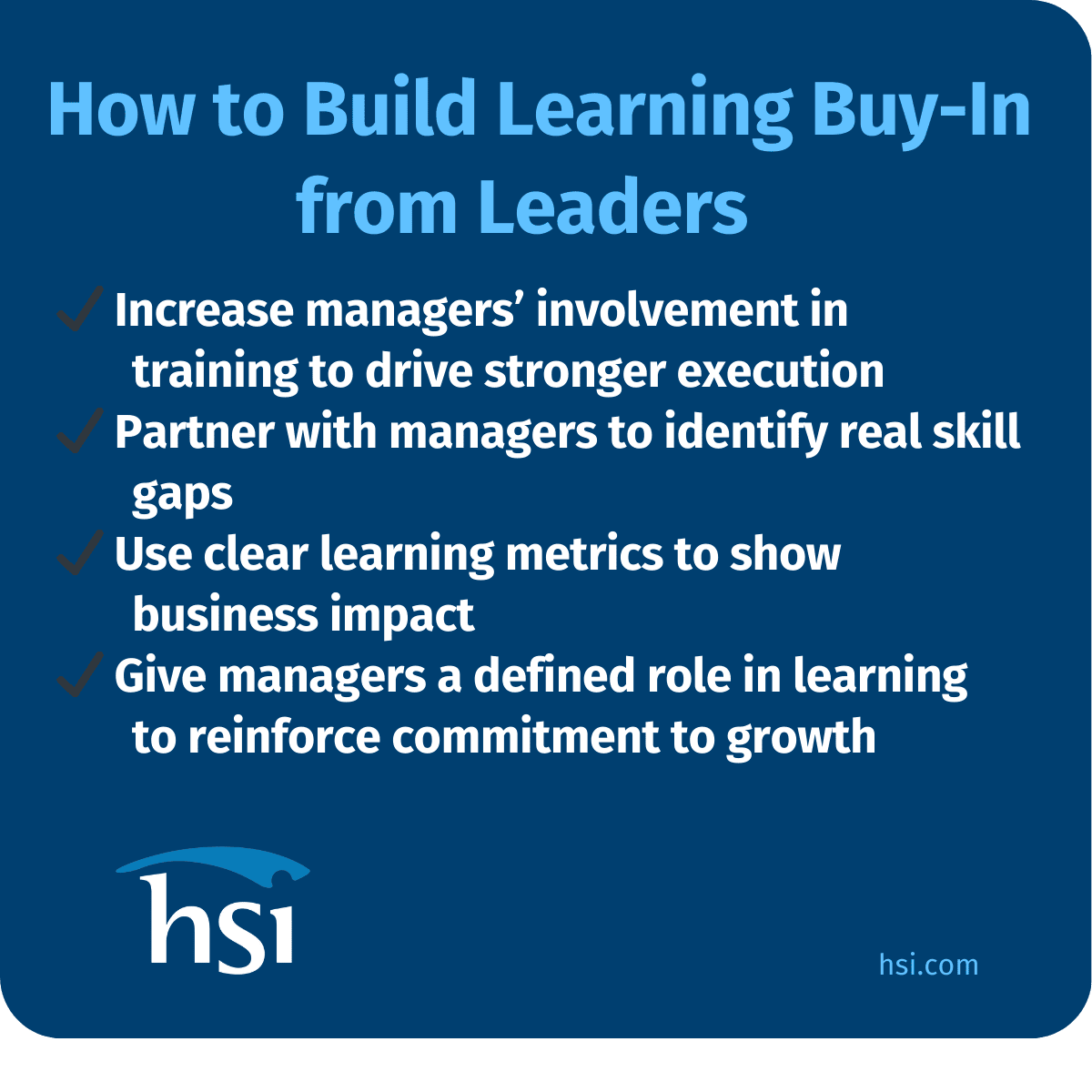
- Have managers tell you what they are looking for. Since L&D professionals interact with c-suite executives and directors, they rely heavily on managers to provide insights into employees’ pain points and where they want to see continuous improvement. By understanding what employees need, L&D professionals can better advocate for and implement a learning strategy that aligns with shared organizational goals.
- Create learning metrics. Developing quantifiable and reasonable metrics is critical to evaluating the overall return on expectations (ROE) for a learning program. If executives don’t see a positive impact, they are less likely to invest in additional organizational resources and less likely to make time in their schedules to participate. Metrics help hold everyone accountable and give managers a framework for providing more inclusive feedback to team members.
- Create a specific role for managers. Since managers interact more directly with their team members than HR or L&D, ensure they play a role in learning execution. Sending messages directly from the leadership team helps foster buy-in from the top down, which can encourage reluctant employees to participate. For example, creating events such as Lunch and Learns or Town Hall meetings, facilitated by HR, L&D, and/or c-suite executives is a great way to reinforce the organization’s and leadership’s commitment to employee growth.
Gallup indicates in the State of the American Manager: Analytics and Advice for Leaders, that managers account for at least 70% of the variance in employee engagement scores across business units. Separately, organizations that make strategic investments in learning and development report 11% higher profitability and have twice the employee retention rate compared to those that do not, according to Gallup. Viewed together, these findings underscore the measurable impact managers have on both engagement and business outcomes. Because managers are the primary interface through which employees experience organizational learning, those who actively support and promote training initiatives are positioned to significantly influence engagement levels and satisfaction with the learning program.
How Can Executives and Leaders Reinforce Training to Team Members?
Business leaders across the entire organization have a responsibility to their team members to encourage them and provide the necessary support for their growth. This also means that executives and leaders must carve out time to model what personal growth and development look like. In a workplace where many employees leave their jobs because of a lack of development opportunities, a new or potential hire seeing a CEO participate in a learning moment leaves a lasting impression. People want to work for organizations and business leaders that are committed to future-proofing their skills and recognize that learning is an ongoing journey—regardless of their tenure and position.
“The single biggest driver of business impact is the strength of an organization’s learning culture.” - Josh Bersin, Global HR talent and workplace analyst
Ways to Engage Senior Leaders
Forbes Human Resources Council outlines ways to help upskill senior and executive leaders:
- Support their delegation. Remind senior leaders and executives (especially those newly promoted) that their role is more advisory than before, requiring them to step back and motivate their teams to grow and perform. By encouraging senior leaders and executives to practice delegating, they’re building up the next level of their leadership skills and have an opportunity to create stronger relationships with their team members.
- Let leaders specialize. Ever heard the phrase, “Jack (or Jane) of all trades, master of none”? Although a figure of speech, it does a good job of explaining how taking on too many things makes it hard to be great at any of them. At the organizational level, try structuring your senior and executive teams so that everyone has a particular function that reports directly through them. Making your leadership team a group of specialists empowers them and provides a greater sense of connectedness to the business goals and direction.
- Utilize executive peer groups and 360-degree reviews. Consider holding monthly or quarterly meetings where senior leaders and executives can brainstorm, share wins and challenges, and learn from one another. This allows them to return to their team members with more innovative ideas and new ways to solve problems. It also helps strengthen the organizational culture from the top down. Incorporating 360-degree reviews into an executive’s overall performance helps maintain accountability and minimizes bias that can influence how they view their progress.
- Encourage two-way communication with direct reports. Everyone deserves to feel valued in the workplace. Senior leaders and executives must make recognition and appreciation a core part of their managerial role. Effective organizations make communication a priority, and they provide resources to help team leaders and employees have meaningful discussions. Providing senior and executive leaders with learning on topics such as inclusive feedback can help build a culture of belonging for employees and shared buy-in for organizational goals and expectations.
Even the most well-intentioned senior and executive business leaders can struggle to walk the talk and make time for training. It’s important to acknowledge that employees are looking for leadership to model these behaviors and establish professional development as an organizational priority. By incorporating learning at all levels, your organization sends a clear message that you are investing in your people and supporting the mindset that learning is an ongoing journey. Everyone has room to grow, including your CEO.
HSI Can Help
By managers nurturing their team’s desire to learn creates a culture of learning. According to a seminal study by Bersin by Deloitte, this, in turn, increases the chances by 30% that the organization will be a market leader.
Employees in a learning culture have a growth mindset and benefit from self-directed learning. Our course library includes off-the-shelf training videos tailored to each employee’s unique needs.
We offer a range of valuable leadership training courses to help executives become great leaders. Our microlearning courses include topics such as leadership development, communication, and emotional intelligence—and many other soft skills that are modern and relevant for executives across industries and company sizes.
For more tips on building a great foundation as a leader, be sure to check out our most popular leadership courses on everything from motivational techniques to building an effective leadership team and more.
Reach out to request a consultation.
Related Articles
The Four Types of Learning Cultures
In this white paper, we identify four main types of learning cultures businesses use, and how they differ in terms of...
Resources

LMS Feature Checklist: Buying an LMS and Making the Right Choice
Making the right choice when buying an LMS requires knowing what features you need when comparing platforms. Our blog...
Employee Training & Development
Preparing Employees for a Bigger Role
Learn how leaders can provide the right support structure to help employees step into bigger roles.
Employee Training & Development