Psychological Safety vs. Psychosocial Safety: Why Modern Safety Programs Need Both

Key Takeaways
- Physical safety protects people from hazards, psychological safety helps people speak up about hazards, and psychosocial safety helps prevent workplace conditions that create hazards in the first place.
- Employees can be physically safe and still not feel safe speaking up. Closing that gap is critical to preventing incidents before they occur.
- Psychological safety creates a culture where people can ask questions, report concerns, admit mistakes, and share ideas without fear of blame or punishment.
- Psychosocial safety focuses on identifying and reducing workplace stressors such as excessive workloads, poor communication, unclear expectations, conflict, and bullying.
- Organizations that foster both psychological and psychosocial safety are better positioned to reduce risk, improve reporting, strengthen engagement, and support overall workplace well-being.
Feeling Safe vs. Being Safe at Work
For decades, workplace safety has focused on preventing physical harm. Organizations invest in training, procedures, personal protective equipment, inspections, and compliance programs designed to keep people safe on the job.
Those efforts remain essential. But organizations are increasingly recognizing another reality: A worker can be physically protected and still not feel safe.
Some workers may hesitate to report a concern. They may worry about speaking up in a meeting. They may stay silent about a near miss, a mistake, or a growing workload issue not because they don’t care, but because past experience has taught them that speaking up carries a risk..
When that happens, important information stays hidden, problems go unresolved, and risks can go unnoticed.
This is where psychological safety and psychosocial safety enter the conversation.
While the two terms are often used interchangeably, they address different aspects of workplace safety. Understanding the difference is critical for organizations looking to build safer, healthier, and higher-performing workplaces.
What Is the Difference Between Feeling Safe and Being Safe?
Consider a manufacturing facility with strong physical safety controls.
Employees receive safety training. Equipment is maintained. Procedures are documented. PPE is readily available.
On paper, the workplace appears safe.
But what if employees are worried about being blamed for mistakes? What if workers avoid reporting hazards because they fear criticism? What if team members stay quiet when they notice a potential problem?
In that environment, employees may be physically safe, but they don't necessarily feel safe. The gap between those two experiences can have serious consequences.
A safety program is strongest when people not only have protection from hazards but also feel comfortable identifying, discussing, and addressing risks before incidents occur.
What Is Psychological Safety?
Psychological safety refers to an environment where people feel comfortable speaking up without fear of embarrassment, punishment, or negative consequences. Employees feel safe asking questions, raising concerns, sharing ideas, and admitting mistakes.
In psychologically safe workplaces, employees are more likely to:
- Report hazards and near misses
- Ask questions when something seems unclear
- Admit mistakes before they become larger problems
- Share ideas that improve operations and safety
- Challenge assumptions when risks are overlooked
When psychological safety is missing, the opposite often occurs. Concerns go unspoken, important information remains hidden, and decisions get made with incomplete information. More reports, near-miss submissions, or questions are not necessarily indicators of a worsening environment. In many cases, they reflect a workplace where employees feel safe speaking up and confident that their concerns will be heard.
What Is Psychosocial Safety?
While psychological safety focuses on whether people feel comfortable speaking up, psychosocial safety focuses on the workplace conditions that affect mental well-being and performance.
Psychosocial hazards are aspects of work that can cause stress or harm. These hazards may arise from work design, management practices, workplace environments, or interpersonal interactions.
Common examples include:
- Excessive workloads
- Long shifts
- Fatigue
- Poor communication
- Unclear expectations
- Lack of support
- Workplace conflict
- Bullying or disrespectful behavior
- High-pressure work environments
Over time, exposure to these hazards can increase psychosocial risk, affecting employees' health, safety, and performance. The longer and more frequent the exposure, the greater the potential impact.
Organizations that focus on psychosocial safety work to identify and reduce these hazards before they contribute to stress, errors, incidents, absenteeism, or turnover.
Why Psychological Safety and Psychosocial Safety Work Together
Think about a team dealing with excessive workload and unrealistic deadlines.
Those are psychosocial hazards.
Now imagine employees recognize the problem but don't feel comfortable discussing it.
That's a psychological safety issue.
The organization faces two risks simultaneously:
- The underlying hazard continues.
- Nobody feels safe enough to talk about it.
Over time, this combination can contribute to burnout, stress, disengagement, increased errors, absenteeism, and turnover. It can also allow problems to escalate because warning signs aren't raised or addressed early.
In psychologically safe teams, employees are more willing to speak up about concerns, allowing potential psychosocial hazards to be addressed before they grow into larger issues. Psychological safety and psychosocial safety reinforce one another. One creates the conditions for open communication. The other addresses the workplace factors affecting well-being and performance.
The Role of Safety Leaders
Safety leaders have traditionally focused on identifying physical hazards. Today's workplace requires a broader approach.
Leaders should ask questions such as:
- Do employees feel comfortable raising concerns?
- Are mistakes treated as learning opportunities or sources of blame?
- Are workloads contributing to fatigue or stress?
- Do workers have clear expectations and adequate support?
- Are employees reporting concerns through available channels?
- Are people participating openly in safety discussions?
The answers can reveal risks that may not appear on a traditional safety inspection checklist.
Building a More Complete Safety Culture
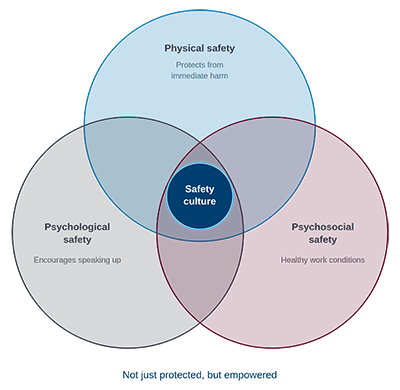
Organizations don't need separate programs for physical safety, psychological safety, and psychosocial safety. Instead, they should think of them as connected parts of a modern safety culture.
Physical safety protects people from immediate harm.
Psychological safety encourages people to speak up when something isn't right.
Psychosocial safety addresses workplace conditions that can affect well-being, decision-making, and performance.
Together, they create an environment where employees are not only protected, but empowered. That may be one of the most important indicators of workplace safety: not simply whether employees are safe, but whether they feel safe enough to help keep everyone else safe too.
Take the next step toward a safer, more open workplace
Creating psychological safety takes more than awareness. It takes everyday behaviors that encourage people to ask questions, share concerns, and speak up when something does not feel right.
Explore HSI training designed to help employees and managers build those skills:
Related Articles
The Missing Link in Safety Programs: Why Psychological Safety Matters
How Trust Improves Safety Performance
Workplace Safety
How Safety Training Reduces Costs and Increases Productivity
Financial Benefits of Safety Training: Reduced Costs & Increased Productivity
EHS Environmental, Health & Safety

Leading with Well-Being: How Leaders Create a Healthier Workplace
Learn how leaders can create a healthier workplace by prioritizing employee wellbeing to support employee and...
Employee Training & Development