NERC Certification Exam
Everything You Need to Know About the NERC Certification Exam
How do utility professionals ensure a reliable power system? One key factor: certified system operators and the NERC certification exam.
What is NERC Certification and Why Is It Required for System Operators?
The North American Electric Reliability Corporation (NERC) oversees the reliability of the bulk power system across North America. To ensure grid operations are handled by qualified personnel, NERC requires system operators who perform real-time tasks essential to the reliability of the electrical grid to earn system operator certification.
The NERC System Operator Certification Program certifies skilled and qualified system operators to ensure the reliability of bulk power systems. This program provides the framework for operators to get certified in one of four NERC credentials:
- Reliability Coordinator (RC)
- Balancing, Interchange, and Transmission Operator (BIT)
- Transmission Operator (TO)
- Balancing and Interchange Operator (BI)
By passing a NERC certification exam, you demonstrate your understanding of NERC Reliability Standards and key operational principles – opening doors to a critical, rewarding career in energy operations.

Who Is Eligible to Take the NERC System Operator Certification Exam?
Anyone who wants to work as a certified system operator can apply. While utilities may have specific education or experience requirements, passing the NERC system operator certification exam is a foundational step in proving your qualifications.
How the NERC Certification Exam is Structured and Scored
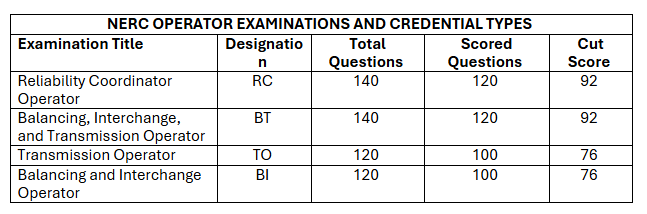
The four NERC certification exams are computer-based, multiple-choice tests designed by subject matter experts (SMEs) and aligned with the official NERC exam content outline. Each exam is three hours long and includes a mix of scored and unscored (pilot) questions.
How to Register for the NERC Certification Exam
- Create an account in SOCCED (System Operator Certification and Continuing Education Database)
- Register and pay for the exam
- Receive an email from Pearson VUE, the testing vendor, to schedule your test
- Schedule and take your exam within one year of registration
To withdraw before your eligibility period ends, submit a request through the SOCCED Help Center by close of business the day before your year is up. You will be reimbursed, except for a withdrawal fee. If you don’t submit a request before your year is up, you’ll lose the full exam cost.

What to Expect on NERC Exam Day at a Pearson VUE Testing Center
Arrive at the test center 30 minutes early and plan for about four hours total. You must bring two valid IDs:
- Primary ID: Government-issued with your photo and signature (e.g., passport, driver’s license)
- Secondary ID: With your name and either a photo or signature (e.g., credit card, employee badge)
Strict test center rules apply. No phones, notes, calculators, or personal items are allowed.

NERC Exam Testing Center Rules
The following regulations apply during testing:
- Depending on the testing center, late arrivals may not be allowed to sit for the exam. If so, they will be considered no-shows and must reapply and pay the full test fee again to take the exam.
- You cannot bring reference materials, calculators, cell phones, or recording equipment into the exam. Some testing centers may not have lockers to accommodate personal items, so do not bring anything other than your IDs into the test center.
- You can’t take any test materials, documents, notes, or scratch paper of any sort from the exam (pencils, paper, and an online calculator will be provided).
- Visitors are not permitted during the exam.
- Testing center staff can only answer questions about testing procedures. They can’t respond to questions about the exam’s content.
- You may use the restroom during the exam. However, the exam clock will continue running.
- You can’t leave the testing center until you have finished the exam.
- You can’t smoke in the testing center.
- Any candidate giving assistance, receiving assistance, or making a disturbance will be required to turn in their exam materials and leave the testing center. A Disciplinary Action Procedure will be initiated once NERC is notified about the incident.
- Any instances of cheating or attempts to impersonate another candidate will be dealt with through the Disciplinary Action Procedure.

Passing and Failing the NERC Certification Exam
What Happens if You Fail the NERC Certification Exam?
You must wait 42 days to retake the exam. A new registration and fee are required through SOCCED.
What Happens After You Pass a NERC Certification Exam?
Once you pass a NERC credential exam, you’ll receive a certification valid for three years. You can’t retake the same exam during that time unless your certification expires or lapses.
SOCCED automatically tracks your expiration date, which is four years from the exam pass date. To stay certified, you’ll need to meet the credential maintenance requirements.

Nerc Certification Maintenance Requirements And Continuing Education Hours (CEH)
To maintain your NERC certification, you must earn Continuing Education Hours (CEHs) through NERC-approved training activities. These can include:
- Operator training simulators
- Emergency drills and restoration exercises
- NERC standards training
- Scenario-based or tabletop exercises
Your certification is valid for three years.
Once you meet the requirements and pay for your renewal in SOCCED, NERC issues a new certificate with a new expiration date.
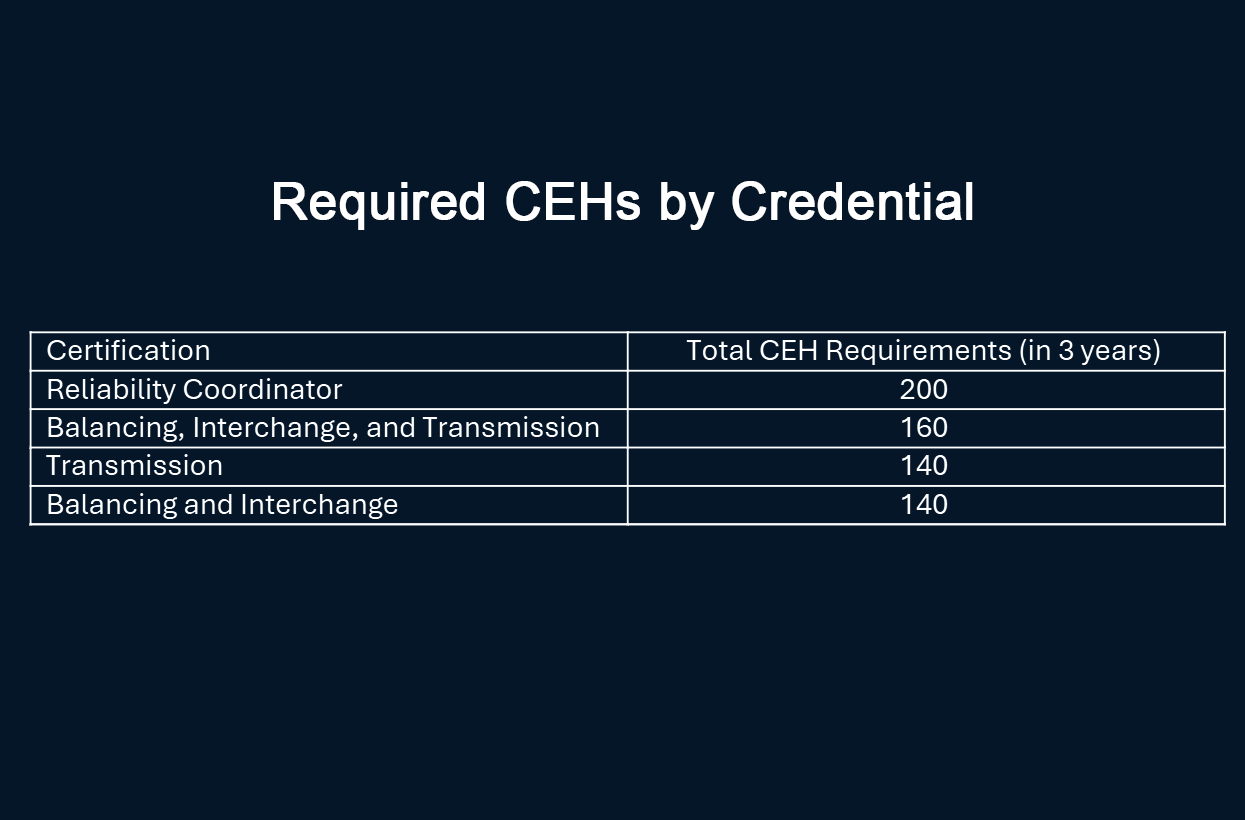
CEHs must include:
- 30+ CEHs on NERC standards or their implementation.
- 30+ CEHs using simulation or emergency response training.
If you don’t meet these within three years, your credential enters a one-year suspension. During this time, you may not perform any NERC-certified duties. If you still don’t meet the CEH requirements after the suspension, the credential expires.
You can accumulate the proper number and type of CEHs during the suspension period and have your credential reinstated with the original expiration date (three years after the previous expiration date).
NERC counts CEHs from a course or training once a year, based on your certification date. If the training focuses on emergency preparedness, communication, troubleshooting, or responding to emergencies, it can also count as an emergency operations course. These emergency courses can be used for credential maintenance up to twice a year.

How to Effectively Prepare for the NERC Certification Exam
If you want to be a system operator or manage a team that works on the bulk electric system then the NERC certification exam is likely on your radar. It’s more than a requirement – it’s a serious professional milestone.
Whether you're the one taking the test or the one responsible for preparing your team, we’ll help you understand what to expect, how to prepare, and what tools can make the process more manageable.
How to Choose the Right NERC Certification Exam for You
There are four different NERC certification exams:
- Reliability Coordinator
- Balancing and Interchange
- Transmission Operator
- Balancing, Interchange, and Transmission
Each exam covers the same core knowledge areas but emphasizes different operational responsibilities. The best first step? Review the NERC Content Outlines for each exam.
These outlines list:
- Six main knowledge categories
- The number of questions per area
- A list of ~30 Reliability-related tasks common across all exams
This outline is your study blueprint – don't skip it.

How To Start Studying For The Nerc Certification Exam
Use a NERC Certification Prep Program that follows the official content outline
Most successful candidates use a formal exam prep program. Given the sheer volume of material, it's essential to choose one that follows NERC’s content structure closely.
Tip for Employers: If you're investing in a training partner, make sure they offer:
- Content aligned with the NERC exam blueprint
- Real-time access to instructors (email, Q&A sessions, office hours)
- Application-focused learning – not just memorization
- Tools to monitor employee progress and reinforce weak areas
Use the NERC recommended study resources without getting overwhelmed
NERC publishes a list of recommended reference materials on its Exam Preparation Resources page. Be warned: they can be overwhelming – the EPRI Power System Dynamics Tutorial is over 1,000 pages.
Instead of letting it overwhelm you, try this:
- Use the content outline to guide what you study and when
- Break readings into chunks that align with each knowledge area
- Take notes on areas that are unclear so you can revisit them
Pro tip: EPRI and other technical documents are best digested after you’ve seen the concepts in training, so they reinforce rather than confuse.
Remember, the NERC Certification Exam tests application, not memorization
Let’s get real – this isn’t a trivia quiz.
Sure, you’ll encounter a few recall-based questions, especially around NERC standards or “thumb rules.” But most of the exam is application-based. You need to:
- Understand core reliability concepts
- Analyze operational scenarios
- Choose the most effective action – not just a technically correct one
Sample question:
Voltage at a critical bus has dropped to 95%. Which of the following actions is most appropriate for this situation?
- Place a shunt reactor in service at the bus
- Increase reactive power output from local generators
- Place a shunt capacitor in service at the bus
- Increase real power output from local generators
Answer: C – because static reactive resources (like shunt capacitors) should generally be used before dynamic ones (like generator VARs).
In the question, two actions would help increase voltage at the bus, but placing a shunt capacitor in services should be the first action taken, versus increasing the reactive output of a generator.
How Learning Styles Impact NERC Exam Success
Some people thrive with independent study. Others need instructor-led guidance and real-world examples. The best programs offer a blended approach:
- Online modules for core content
- Instructor-led training for applying what you've learned
- Simulation to practice decision-making in realistic scenarios
And don’t forget post-course support – especially important for teams. Tracking scores on practice exams, identifying trends, and reviewing tough topics can make the difference between passing and frustration.

What to Do After Failing the NERC Certification Exam
Didn’t pass the NERC exam? It’s not the end of the road. Remember, the exam is intentionally difficult. Many people need more than one attempt. After taking time to process your disappointment, review your results to identify what held you back, adjust your study strategy, and use the required 42-day waiting period to regroup. Focus on understanding concepts, not memorizing answers. When you’re ready to try again, apply solid test-taking habits and trust your preparation. With the right plan and mindset, you can pass on your next attempt.

How to Prepare to Take the NERC Certification Exam Again
Start by letting yourself be upset. Failing an exam can be frustrating. It’s OK to be discouraged, and you should recognize the disappointment of not meeting your goal.
Many candidates fail their first attempt. The NERC certification exam is a unique experience. It’s designed to test how you apply what you’ve learned, not just to make sure you understand the concepts.
Next, once you’ve had time to process the results, it’s time to make a constructive plan for the next attempt. Ask yourself:
- What went wrong?
- What went well?
These answers will guide you in your next steps.
NERC requires a 42-day waiting period before you retake the exam. While this may seem like a long time, you can use it to create a plan and put it into action.

How to Analyze Your NERC Exam Results and Identify Weak Knowledge Areas
Start by reviewing your exam results. Understanding where you went wrong is key to knowing how to move forward.
- Review content areas where you struggled during the exam. NERC provides results by content area so you can determine your weak areas.
- Identify specific topics or question types that were the most challenging.
- Look for patterns. Did your mistakes come from lack of knowledge, misunderstanding concepts, or poor time management?
- Did “test anxiety” play a role in your results?

How to Adjust Your Study Strategy for a NERC Exam Retake
Now that you know your weak areas, it’s time to develop a plan to address them:
- Prioritize areas where you scored the lowest. Spend extra time on those areas and practice applying the concepts to real-world grid situations.
- Emphasize understanding over memorization. The NERC exam is application-based so you have to know how to apply everything you’ve learned.
- Develop a study plan. If you didn’t have one before, put one together this time. If you did, update it to concentrate on your weak areas
- Don’t forget the information you know. Don’t focus on your weak areas at the expense of your strengths. Make sure you review everything.
- Limit practice tests. They’re helpful but taking too many leads to memorizing answers instead of learning how to apply concepts.
Where should you start? Go back to the basics. Review core reliability concepts and operational scenarios. Use your training to identify the most effective action, not just the technically correct one. The NERC exam gives you multiple options that could be correct on a question. Your job is to pick the best option.
If you haven’t used a structured training program before, consider enrolling in one now. If you did, talk with the instructors about where you struggled. They can help you focus on key areas to improve your performance on your next attempt. Ask the providers what their pass-rate history is. How successful are they in getting people certified?
It may seem like a good idea to use ChatGPT or another artificial intelligence program to help address scenarios. Use AI tools with caution. They can be useful for practice, but don’t take anything at face value. Always double check information against reliable sources.

Proven Test-Taking Strategies for the NERC Certification Exam
When you’re ready to try again, keep these strategies in mind:
- Rest and eat well before the exam. Clear focus requires energy.
- Apply your knowledge, don’t just remember it. Many questions are situational.
- Anticipate that multiple answers may seem correct. Focus on identifying the best answer.
- Eliminating wrong answers is sometimes the best way to get to the correct answer.
- Read each question carefully, especially the final line in long scenarios.
- Answer the easy questions first, then go back to the harder ones.
Remember, the NERC certification exam is tough because certified operators play a critical role in grid reliability. You may have failed the exam this time, but it’s a stepping stone to success. Now you know what to expect and how to better prepare. With the right approach, preparation, and mindset, passing is within reach.