Environmental Health Safety (EHS) Acronyms
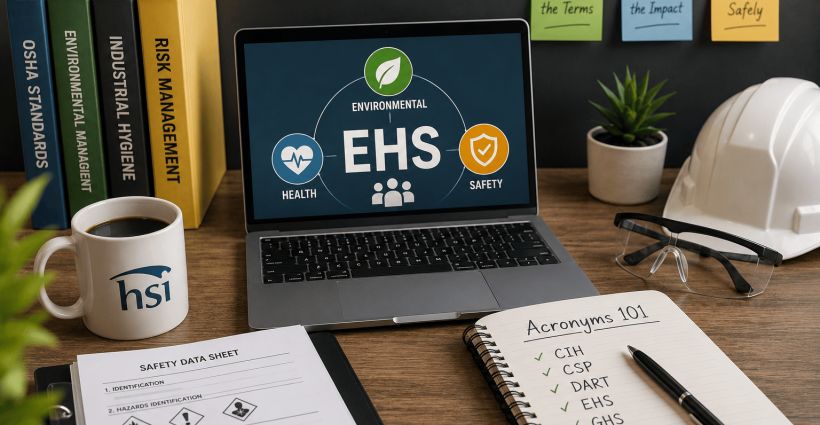
Industry acronyms and abbreviations can make communication and reporting easier but not if workers don't understand their meanings.
This article provides a brief overview of some of the most common EHS acronyms and abbreviations. Whether workers are new to the health and safety industry or long-time professionals, they’ll find this helpful. For a quick reference, the list is in alphabetical order and the terms link to additional information.
BBS – Behavior-Based Safety
BBS is a workplace safety approach that focuses on observing and reinforcing safe behaviors to help prevent incidents and injuries.
CAPA – Corrective and Preventive Action
CAPA represents a structured process used to identify, investigate, and address problems while stopping similar issues from recurring. It typically includes root cause analysis, corrective actions, and preventive measures.
CIH – Certified Industrial Hygienist
CIH is the professional certification for the industrial hygiene (IH) field. The credential is the global standard for certification in protecting the health and safety of employees and the public by anticipating, recognizing, evaluating, and controlling chemical, physical, ergonomic, or biological hazards. Workers must maintain their certification through continuing education and professional development activities that meet the Board for Global EHS Credentialing (BGC) requirements.
CSP – Certified Safety Professional
A CSP is a safety practitioner who helps organizations identify workplace hazards, reduce risk, investigate incidents, prepare emergency response plans, and support meeting health and safety regulations. The credential requires education, experience, a certification exam, and ongoing professional development.
DART – Days Away, Restricted or Transferred
DART is one of the metrics used by OSHA for measuring workplace injuries and illnesses that result in days away from work, restricted work activity, or job transfer.
EHS – Environmental Health and Safety
EHS refers to the practices organizations use to protect employees, communities, and the environment while maintaining compliance with applicable regulations. EHS, EH&S, ESH, and HSE are common variations of the term.
EMIS – Environmental Management Information System
EMIS refers to computer-based technologies that support the environmental management system through systematically collecting, processing, and making relevant environmental information available.
EMS – Environmental Management System
An EMS is an organized framework organizations use to manage environmental responsibilities, improve environmental performance, and support regulatory compliance.
EPCRA – Emergency Planning and Community Right-To-Know Act (also known as SARA Title III)
EPCRA is a U.S. law that supports state and local emergency planning and provides communities, emergency responders, and government agencies with information about hazardous chemicals present in their area.
EU CLP – EU Classification, Labelling and Packaging (CLP) Regulation
In 2008, the European Union adopted the CLP regulation, to coordinate the classification, labeling, and packaging of chemical substances and mixtures within the UN's Globally Harmonized System of Classification and Labeling of Chemicals (GHS). The regulation helps ensure chemical hazards are communicated clearly through standardized requirements.
GHS – Globally Harmonized System of Classification and Labeling of Chemicals
GHS is a United Nations system for defining health, physical, and environmental hazards of chemicals. First published in 2003, it provides standardized hazard communication elements, including labels and safety data sheets (SDS).
HAPs – Hazardous Air Pollutants
HAPs are air pollutants known or suspected to cause cancer or other serious health and environmental effects. The EPA regulates them under the Clean Air Act (CAA).
HAZCOM – Hazard Communication
OSHA’s Hazard Communication Standard (29 CFR 1910.1200) requires chemical hazards to be classified and communicated to workers through labels, safety data sheets (SDSs), and employee training.
HMIS – Hazardous Materials Identification System
HMIS is a voluntary hazard rating system developed by the American Coatings Association to help employers comply with OSHA labeling requirements. It uses colors, numbers, and letters to communicate chemical hazards and recommended protective measures.
IH – Industrial Hygiene
The science and practice of anticipating, recognizing, evaluating, and controlling workplace environmental factors that may cause illness, injury, or discomfort. Common industrial hygiene concerns include chemical exposures, noise, heat stress, and airborne contaminants.
ISO – International Organization for Standardization
ISO is an international standards organization, founded in 1947, that develops widely recognized standards in quality, environmental management, safety, and technology. Many ISO standards are relevant to workplace health and safety, including ISO 14001, which specifies requirements for an environmental management system (EMS).
ISO 45001 – Occupational Health and Safety Management System Standard
ISO 45001 is an international standard that specifies requirements for an occupational health and safety (OH&S) management system. It helps organizations improve workplace safety, reduce risks, prevent work-related injuries and illnesses, and continually improve performance.
JSA – Job Safety Analysis
JSA is a formal method used to identify potential hazards within specific job tasks and determine the safest way to perform them. Each step is evaluated for potential risks and appropriate controls to reduce accidents, injuries, and illnesses. This process is also commonly called a Job Hazard Analysis (JHA).
LOTO – Lockout/Tagout
LOTO refers to OSHA’s control of hazardous energy procedures that protect workers during equipment servicing and maintenance. OSHA standard 29 CFR 1910.147 requires energy control procedures that prevent machines from unexpectedly starting or releasing stored energy. Proper LOTO procedures help prevent serious workplace injuries such as electrocution, amputations, crushing injuries, and burns.
MOC – Management of Change
MOC is a formalized approach used to evaluate, review, and manage changes to processes, equipment, chemicals, technology, procedures, or facilities before implementation. It helps organizations spot potential risks and maintain safety, compliance, and operational soundness when changes occur.
OHS – Occupational Health and Safety
OHS focuses specifically on protecting worker health, safety, and well-being in the workplace. OHS programs help identify, assess, and control workplace hazards, including physical, chemical, biological, ergonomic best practices, and psychological risks. OHS is also commonly referred to as occupational safety and health (OSH).
OHSAS – Occupational Health and Safety Assessment Series
OHSAS 18001 was a former occupational health and safety management system standard that was replaced by ISO 45001. However, the term OHSAS may still appear in older documentation, certifications, and safety management discussions.
PE – Professional Engineer
PEs are licensed engineers who meet state education, experience, and examination requirements and are legally authorized to approve engineering plans and provide engineering services to the public.
PEL – Permissible Exposure Limit
A PEL is a legally enforceable occupational exposure limit established by OSHA for exposure to a chemical substance or physical agent, such as noise. PELs are typically expressed as an 8-hour time-weighted average (TWA) and represent the maximum allowable workplace exposure under OSHA regulations. Employers use PELs to evaluate potential hazards and implement measures to keep employee exposures within regulatory limits.
PPE – Personal Protective Equipment
Personal protective equipment (PPE) refers to protective clothing, helmets, goggles, and other garments or equipment designed to protect the wearer’s body from injury or infection. The hazards addressed by protective equipment include physical, electrical, heat, chemical, biohazard, and airborne particulate matter. PPE is commonly used when hazards cannot be fully eliminated or controlled through engineering and administrative controls.
PSM – Process Safety Management
PSM is an extensive approach to preventing releases of highly hazardous chemicals. PSM programs help organizations identify, evaluate, and control process hazards through measures such as employee training, operating procedures, and hazard analyses.
RCA – Root Cause Analysis
RCA is a method used during incident investigations to identify what happened, why it happened, and how to stop similar incidents from recurring.
RCRA – Resource Conservation and Recovery Act
RCRA is the principal federal law in the United States governing the generation, transportation, treatment, storage, and disposal of hazardous and solid waste. The Act gives the EPA authority to regulate hazardous waste from generation through disposal.
REL – Recommended Exposure Limit
REL is an occupational exposure guideline developed by NIOSH to help protect workers from hazardous substances and workplace hazards. Unlike PELs, RELs are not legally enforceable standards, and are based on NIOSH's evaluation of available scientific and technical information.
RTK – Right to Know
Under OSHA’s Hazard Communication Standard, workers have the right to know about hazardous chemicals present in their workplace and to receive information that enables them to work with or around the chemicals safely.
SaaS – Software as a Service
SaaS is a software delivery model in which applications are hosted centrally and accessed over the internet. SaaS applications are typically licensed on a subscription basis and don't require local installation.
SDS – Safety Data Sheet
SDS is a standardized document that provides information about the properties, hazards, safe handling, storage requirements, protective measures, and emergency response actions for chemicals, chemical compounds, and chemical mixtures. OSHA's Hazard Communication Standard requires SDSs to follow a consistent 16-section format to help users quickly locate important safety information. Before the adoption of GHS, SDSs were commonly referred to as Material Safety Data Sheets (MSDSs).
SIF – Serious Injury and Fatality
In workplace safety, SIF refers to incidents that result in a serious injury or fatality, or incidents that had the potential to result in such an outcome. Organizations use SIF analysis to identify high-risk activities and prioritize prevention efforts toward workplace hazards with the greatest potential consequences.
TLV – Threshold Limit Value
TLV is an occupational exposure guideline established by the American Conference of Governmental Industrial Hygienists (ACGIH). TLVs are intended to represent airborne concentrations of substances that most workers can be repeatedly exposed to without experiencing adverse health effects. Although TLVs are not legally enforceable by OSHA standards, many organizations use them as best-practice exposure guidelines when evaluating chemical hazards and workplace air quality.
TRI – Toxic Release Inventory
TRI is a program that tracks the management of certain toxic chemicals that may pose a threat to human health and the environment. United States facilities in different industry sectors must report annually how much of each chemical is released to the environment and/or managed through recycling, energy recovery, and treatment.
TRIR – Total Recordable Incident Rate
TRIR is a metric used by OSHA for measuring workplace injuries and illnesses. It calculates the number of recordable incidents per 100 full-time workers during a one-year period. Organizations often monitor TRIR as a main indicator of workplace safety performance.
TSCA – Toxic Substances Control Act
The Toxic Substances Control Act of 1976 provides EPA with authority to require reporting, record-keeping, and testing requirements, and restrictions relating to chemical substances and/or mixtures. Certain substances are generally excluded from TSCA, including, among others, food, drugs, cosmetics, and pesticides.
TWA – Time-Weighted Average
TWA is the average concentration of a hazardous substance that a worker is exposed to within a specified period, typically an 8-hour workday. TWAs are commonly used to evaluate workplace exposures and are frequently referenced alongside PELs, RELs, and TLVs.
VOC – Volatile Organic Compound
VOCs are organic chemicals that easily evaporate into the air at room temperature. VOCs are commonly found in products such as paints, solvents, adhesives, fuels, and cleaning agents. Exposure to elevated VOC levels may contribute to health issues including eye, nose, and throat irritation, headaches, dizziness, and respiratory problems. VOCs are closely monitored because they can affect both indoor air quality and environmental emissions.
WHMIS – Workplace Hazardous Materials Information System
Since 1988, WHMIS has served as Canada’s national hazard communication standard and includes labeling containers of WHMIS-controlled products, supplying appropriate SDSs, and deploying worker education and site-specific training programs. WHMIS was updated in 2015 to comply with GHS requirements.
HSI Can Help
HSI can help make your workplace safer and smarter. Our training shares best practices to help improve your safety culture, upskill and retain workers, eliminate regulatory issues, and reduce risk and mitigate it.
Request a consultation to learn more about our employee safety training and ongoing employee development programs.
Additional Resources
Looking for workplace safety associations and organizations? Be sure to check out our blog Workplace Health and Safety Associations and Organizations.